AI reputation management is the work of controlling how accurately and how often AI answer engines describe your brand. It overlaps with review monitoring and PR only at the edges. The mechanism is different: an engine builds its description of you from sources it can retrieve, most of which you do not own, so the lever is what those sources say rather than what your homepage says. Three things decide the outcome: whether engines can fetch your pages, what third-party sources say about you, and whether your own facts are stated plainly enough to be lifted.
| Point | Details |
|---|---|
| It is not review management | Review monitoring watches what customers write. This watches what a model asserts, to a buyer, without either of you present. |
| Most of the evidence is not yours | 84% of the 267,963 citations in our data point at pages the mentioned brand does not own. |
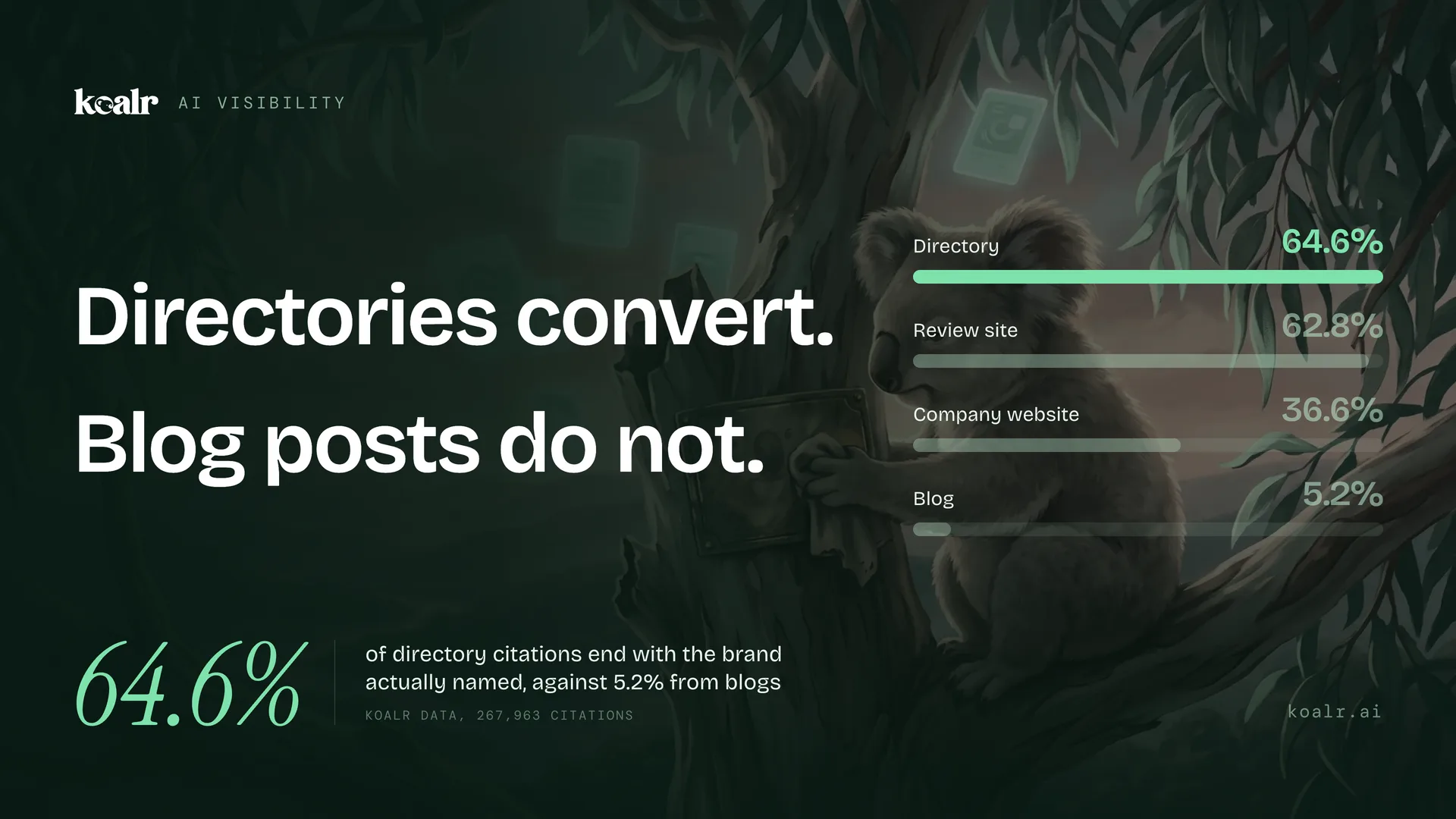
| Source type decides mention conversion | Directories convert citations into brand mentions at 64.6% and blog-type sources at 5.2%, a 12x gap. |
| Crawler access is the silent failure | A blocked bot costs you every engine that uses it, and nothing in your analytics reports it. |
| Wrong is worse than absent | An engine confidently describing a product you discontinued is a support and sales problem, not a marketing one. |
What does AI reputation management actually cover?
It covers what an answer engine asserts about your company when a buyer asks. That splits into three questions worth separating, because they have different owners and different fixes.
Are you mentioned at all? The visibility question. If engines never name you in your category, nothing else on this page matters yet.
Is what they say accurate? The correctness question. Engines confidently describe pricing that changed, products that were retired, and positioning you abandoned two years ago, because a source they trust still says so.
Is the framing helpful? The sentiment question. Being named as the cheap option when you sell on depth is a commercial problem even though every word is true.
What this is not
- Review platform monitoring and response workflows
- PR crisis management and press sentiment tracking
- Social listening for brand mentions on X or LinkedIn
- Removing negative search results from Google
What this is
- What engines assert about you, unprompted, inside an answer
- Which sources they draw that assertion from
- Whether those sources are current and accurate
- Whether a buyer reading the answer would shortlist you
The distinction matters commercially. Review management protects an asset you can see and respond to. This protects a description you never see, delivered to a buyer who never told you they were looking, and which no amount of paid search recovers once it has landed.
Why is most of the work off your own site?
Because most of the evidence is. Across the 267,963 citations we have recorded, 84% point at pages the mentioned brand does not own. When an engine explains your company, it is usually reading someone else's description of you.
That reframes the effort allocation. The instinct is to rewrite the homepage, and the homepage does matter, but it is one source among many and often not the one being read.
Source type turns out to matter more than source volume. Measured across our citation set, the rate at which a citation converts into the engine actually naming the brand varies by more than an order of magnitude:
| Source type | Citations | Mention conversion |
|---|---|---|
| Reference, wiki-like | 7,047 | 65.1% |
| Directory | 19,068 | 64.6% |
| Review site | 4,211 | 62.8% |
| Marketplace | 8,780 | 57.7% |
| Forum | 858 | 39.0% |
| 2,794 | 37.7% | |
| Company website | 229,651 | 36.6% |
| News | 1,543 | 16.4% |
| Video | 4,187 | 15.8% |
| Blog | 1,619 | 5.2% |
A citation on a directory or review site is roughly twelve times more likely to result in your brand being named than a citation on a blog. Company websites make up the overwhelming bulk of citations and convert at a middling 36.6%, which is the clearest argument available for spending less of the quarter on another blog post and more of it on being listed properly.
Can the engines actually fetch your pages?
This is the first check because it is the only one that can take everything else to zero, and it fails silently. A blocked crawler produces no error, no alert and no analytics anomaly. It produces absence.
Two layers block independently, and teams routinely check one:
- robots.txt. Look for explicit directives naming GPTBot, ClaudeBot, PerplexityBot, Google-Extended and Bingbot. A blanket bot-blocking rule added during a scraping scare catches these too.
- The edge. CDN and WAF rules block by user agent and by ASN, often as part of a managed bot-protection ruleset that nobody in marketing knows exists. A crawler can be allowed in robots.txt and refused at the door.
Verifying takes a minute per bot:
curl -A "GPTBot" -sI https://example.com/your-page | head -1
curl -A "GPTBot" -s  https://example.com/your-page | grep -c "the fact you want cited"
The first line confirms you get a 200 rather than a 403. The second confirms the fact is in the raw HTML rather than arriving after JavaScript runs. Both can fail independently, and the second failure is the one that surprises people: a comparison table rendered by a client-side component does not exist from the engine's perspective.
What should you actually track?
Five signals, and the third is the one most reputation dashboards omit.
| Signal | What it tells you | Where it comes from |
|---|---|---|
| Mention rate | Whether you appear at all, per engine | Prompt tracking |
| Share of voice | Whether you are gaining or losing against the field | Prompt tracking across a fixed set |
| Factual accuracy | Whether the description is currently true | Manual read of answer text |
| Cited sources | Which pages the engine believed | Citation tracking |
| Sentiment | How the framing positions you | Prompt tracking, verified by hand |
Factual accuracy cannot be automated away, and it is the signal with the sharpest commercial edge. A score cannot tell you that the engine has your pricing model wrong. Reading twenty answers a month can, and that hour is the cheapest insurance in the programme.
What is the prioritised playbook?
Ordered by speed of return rather than by how interesting the work is. The first three are a sprint; the fourth is a quarter.
1. Confirm access, this week. Run the curl checks above for each crawler, across a representative page of each template type. Fix any 403 before writing a word of content. This is engineering work, it is small, and it gates everything.
2. Fix your own facts, this week. Pricing, product names, category description and company details, stated plainly in server-rendered HTML on the pages that carry them. Engines are not inferring cleverly. They are reading. If your pricing page renders numbers client-side, the number is not published as far as retrieval is concerned.
3. Answer the question under the heading, this month. For each priority page, put a direct 40 to 60 word answer immediately beneath the heading it belongs to, before the supporting detail. Retrieval chunks at headings, so a section that opens with context and buries its answer in paragraph four contributes nothing liftable.
4. Work the off-page programme, this quarter. Directory and review listings first, given the conversion rates above. Consistency across them matters as much as coverage: if three listings describe your category differently, engines hedge, and a hedged description is a weak recommendation. Then the round-ups and communities your category actually gets cited from.
What timeline is realistic?
Different layers move at genuinely different speeds, and conflating them is why programmes get abandoned in month two.
| Layer | Typical lag | Why |
|---|---|---|
| Crawler access fix | Days to weeks | Takes effect at the next crawl |
| Own-site facts and structure | 2 to 6 weeks | Needs a recrawl and, for some engines, a refresh cycle |
| New directory and review listings | 1 to 3 months | The listing must be indexed and then trusted |
| Earned mentions and category authority | 3 to 12 months | Compounds; no single placement moves it |
The honest version is that the fast layers are also the smallest. Fixing crawler access can take you from invisible to present, which is dramatic, but only if you were blocked. If you were not blocked, the work that actually changes your standing is the slow layer, and no tool shortens it.
See where your brand shows up in AI search
Enter your website and get your AI Visibility Score across 7 engines. First score in under 5 minutes, no setup.
What goes wrong most often?
Four failure modes account for most wasted effort.
Blanket bot blocking. Added defensively, forgotten immediately, and it costs whole engines at once.
Content that only exists in JavaScript. The page looks complete in a browser and is empty to a crawler that does not execute scripts.
Near-duplicate pages targeting query variants. Publishing twelve slight rewordings of the same page is scaled content abuse under Google's own guidance, and our own data says it does not work anyway: only 78 of one publisher's roughly 1,549 pages have ever earned a citation.
Buying mentions on low-quality sites. The citation may register and it does not carry the trust signal that makes an engine repeat the claim. It also carries policy risk you cannot unwind.
A practitioner's view on where the money goes
If I had one quarter and a fixed budget, I would spend it in a shape most marketing plans do not: a small slice on engineering, a larger slice on listings and profile work, and the smallest slice on new content. That is close to the reverse of how these programmes are usually funded, and the source-type table above is why.
The uncomfortable part is that the highest-yield work is unglamorous. Claiming and correcting a directory profile is administrative. It produces no asset anyone can put in a board deck. It converts at 64.6% while the blog post that took three weeks converts at 5.2%. I have made the opposite call before, on the reasonable-sounding basis that content is a durable asset and a listing is not, and the visibility data did not reward it.
The second thing I would change is treating accuracy as a separate line item with a named owner. Visibility work gets attention because it has a number attached. Accuracy does not, until a prospect quotes a wrong price back to you on a call. It costs an hour a month to read the answers and catch it, and I have never seen that hour formally allocated to anyone.
Where I would push back on my own argument: the off-page bias assumes your own pages are already adequate. If your homepage does not state plainly what you sell and to whom, no amount of directory work rescues you, because the engines have nothing consistent to match against. Fix the entity first, then buy the distribution.
Where Koalr fits
Koalr tracks what all seven engines say about your brand across a fixed set of buyer prompts, records the sources behind each answer, and scores mentions, share of voice, sentiment and citation rate over time. The GEO Audit covers the access and structure layer, testing crawler reach per bot and flagging pages whose answers are not in the server HTML.
The parts of this playbook that are judgement stay judgement. Reading answers for accuracy, deciding which listings are worth the administrative effort, and choosing what to correct first are yours. Plans start at £79 ($99, €89) a month with a 7-day free trial and all seven engines included.
FAQ
Frequently asked questions
No. Traditional online reputation management deals with reviews, press coverage and search results you can see and respond to. AI reputation management deals with what an answer engine asserts about you inside a response, drawn from sources you mostly do not own, delivered to a buyer who never contacts you. The monitoring surfaces and the fixes are different.
Sources
- Koalr platform data, 267,963 citations: the 84% off-page share and the full source-type mention conversion table. Drawn from our own citation records across tracked brand categories.
- Koalr platform data, 295,746 citations across 23 projects: the page-count and citation concentration figure behind the near-duplicate-pages warning.
- Google's guide to optimising for generative AI features: the primary source on content quality standards and the scaled content abuse policy referenced above.
- How to get cited by AI engines through content you don't own: the tactical version of the off-page programme in step four.
- What is generative engine optimisation?: the wider discipline this sits inside, including schema and entity fundamentals.
- Publishing more pages does not get you cited: the evidence behind the warning against near-duplicate page production.