

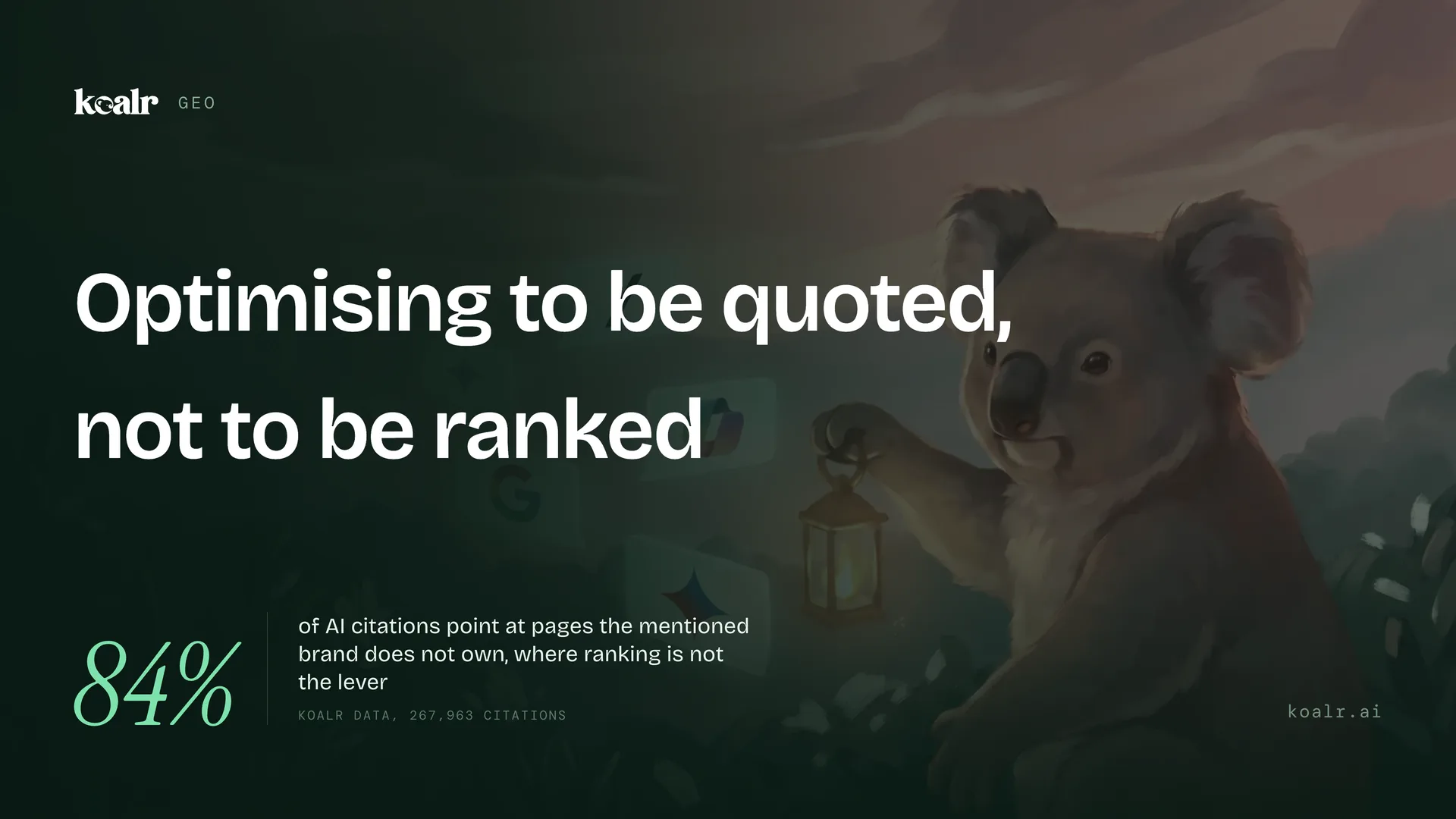
Generative engine optimization (GEO) is the practice of making your brand easy for AI engines to find, quote and recommend, so that when a buyer asks ChatGPT, Gemini or Perplexity a question in your category, the answer names you. SEO earned you a position on a page of links. GEO earns you a sentence inside the answer that replaced it.
OpenAI reported 800 million weekly ChatGPT users in late 2025. Google says AI Overviews reach more than 2 billion people a month. Those users read a paragraph, see three or four brand names, and act on them. If the paragraph skips you, your Google ranking never enters the conversation.
Ask an engine the question this post answers and you can watch the mechanism work:
Buyer asks: “what is generative engine optimization”
Generative engine optimization (GEO) is the practice of optimizing content so that AI engines such as ChatGPT, Google's AI Overviews and Perplexity retrieve, quote and recommend it in their generated answers. Where traditional SEO targets a ranked list of links, GEO targets the answer itself: being used as a source, cited by name, and described the way you intend [1][2].
Perplexity builds definitional answers from whoever published the clearest definition. The sources behind [1] and [2] wrote their way into this answer. That is GEO, demonstrated on itself.
What is generative engine optimization?
Generative engine optimization is the work of earning your brand a place inside AI-generated answers. An AI engine answers a question by retrieving sources, reading them, and composing a reply that names brands and links the pages it leaned on. GEO shapes both sides of that process: publishing content the engine wants to quote, and building the wider footprint that convinces it your brand belongs in the reply.
Two terms carry most of the weight in this field, and they describe different wins:
- A mention is your brand named in the answer text. Mentions drive recommendations: the buyer walks away with your name.
- A citation is your website linked or referenced as a source under the answer. Citations drive authority and the click, when there is one.
You can win either without the other. An engine can recommend your product while citing a review site, or quote your blog post in an answer that recommends someone else. Useful GEO tracks both, prompt by prompt.
How is GEO different from SEO?
SEO earns your pages a position on a results page. GEO earns your brand a place inside the answer a buyer reads instead of that page. The habits transfer less than most teams expect:
| SEO | GEO | |
|---|---|---|
| Surface | Ranked list of links | Generated answer |
| Unit of competition | Your page vs other pages | Your brand vs other brands |
| Success looks like | Position one and a click | A mention, a citation, a recommendation |
| Main levers | Keywords, links, site health | Liftable answers, entity consistency, third-party mentions |
| Feedback loop | Rank trackers, Search Console | Prompt-level answer tracking |
The two share foundations. A crawlable site, fast pages and clear structure help both, and engines still lean on search indexes to find candidate sources. But a page can rank third on Google and never appear in an AI answer, while a Reddit comment gets quoted instead. Optimizing the ranking without watching the answer leaves the new surface to chance.
Where did GEO come from?
The term comes from a 2023 research paper, not a marketing agency. Researchers from Princeton, Georgia Tech, IIT Delhi and the Allen Institute for AI posted "GEO: Generative Engine Optimization" in November 2023, ran controlled tests on how content edits change the share of citations a page wins once an engine is already reading it, and gave the field its name. The engines then spent two years turning their findings into a mainstream problem:
Nov 2023
A research paper names the field
Aggarwal et al. coin GEO and measure how content edits change the citation share a page wins among a fixed set of retrieved sources.
May 2024
Google launches AI Overviews
AI-written answers move to the top of the world's largest search engine, above the organic results SEO spent two decades targeting.
Oct 2024
ChatGPT gets live search
OpenAI wires web retrieval into ChatGPT, turning the most-used chatbot into an answer engine that quotes and links current pages.
2025
AI answers reach the mainstream
Google rolls out AI Mode, its full conversational search experience, and reports more than 2 billion monthly users for AI Overviews.
2026
The default shifts
Google tests AI-first search as the default experience in Chrome. The answer, not the link list, becomes the front door to the web.
The paper is narrower than the shorthand it produced, and worth reading carefully before you spend anything on the strength of it. It holds retrieval fixed: the engine answers from five pre-fetched results, and the measurement is how much of the answer's citation credit each of those five wins. That describes what happens to a page already being read. It says nothing about getting retrieved, which is the harder half of the job and the half most brands are losing.
Later work has tested the same edits with retrieval switched back on, and most of them do not survive the trip. C-SEO Bench (Puerto et al., NeurIPS 2025) ported seven of the paper's nine methods across six domains and found every one of them null. Treat the 2023 findings as the origin of the vocabulary rather than as a menu of guaranteed uplifts.
How do AI engines decide which brands to name?
Engines name the brands their retrieved sources agree on. Ask "best project management tool for a small agency" and the engine runs searches behind the scenes, pulls a set of pages it trusts, and composes a reply from what those pages say. Getting named is two problems in sequence: being in the retrieved set, and being the passage worth quoting.
Inside a source, engines favor passages that answer a question in one clean lift: definitions, numbered steps, comparisons, statistics with a named source, FAQ answers. Engines read vague copy and discard it.
Across sources, engines repeat consensus. If review sites, communities and round-up posts describe your brand the same way, the answer inherits that description. If they describe a competitor instead, the answer inherits that too. That is why finding the prompts where rivals get cited and you do not and earning mentions in pages you do not own sit at the center of GEO, and why a strong Google rank alone guarantees nothing.
Most of what an engine knows about your brand, it learned somewhere you do not control. No amount of ranking reaches those pages, which is the clearest way to see why GEO is not SEO with a new name.
See where your brand shows up in AI search
Enter your website and get your AI Visibility Score across 7 engines. First score in under 5 minutes, no setup.
What does doing GEO look like in practice?
GEO work splits into three jobs: write answers engines can lift, make your site machine-readable, and earn mentions in the places engines already quote.
Write liftable answers. Structure pages around the questions buyers ask, phrased the way they ask them. Open each section with a sentence that answers the question on its own, because that sentence is the unit an engine extracts. Add real numbers, explicit dates and named sources: concrete, extractable facts are the part of the original GEO advice that later research has held up.
Make your site machine-readable. Add schema markup for your organization, products and FAQs, keep your brand described the same way on every page, and keep the site fast and crawlable. Engines parse structure before prose.
Earn mentions off your site. Engines quote Reddit threads, YouTube videos and comparison round-ups as often as vendor pages. A plain-text mention of your brand inside a page an engine already cites can start working faster than a new page of your own. We covered the method in how to get cited through content you do not own.
None of this compounds without measurement. Run the same buyer prompts against the engines on a schedule and record who gets named, as covered in how to track your brand in ChatGPT and Gemini. Koalr does this as a product: it runs your tracked buyer prompts, from 25 per site up to 50, across seven engines, ChatGPT, Claude, Gemini, Perplexity, Microsoft Copilot, Google AI Overviews and Google AI Mode, then returns an AI Visibility Score from 0 to 100 with the prompt-level detail behind it.
Does GEO replace SEO?
No. GEO extends your search work onto a new surface; it does not retire the old one. Google still serves link-based results at enormous scale, and AI engines reach the web through search indexes, so the crawlability and authority you built for SEO remain the ticket to entry. A page that ranks gets retrieved more often. Whether the answer then names you depends on the GEO work above.
Budget-wise, that means reweighting rather than replacing: keep the technical and authority foundations, and move effort from chasing marginal ranking gains toward answer-shaped content and third-party mentions.
Where should you start with GEO?
Start by measuring where you stand, because the gaps decide the plan. Ask the engines your own buyers' questions and read what comes back, or run a free Koalr scan and get the same picture across seven engines in a few minutes.
From the baseline, work the list: find the prompts where a competitor is named and you are absent, pick the one closest to your best product truth, and close it with a page that answers the question in its first sentence or a mention in the source the engine already quotes. Then re-run the prompts next month and watch what moved.
Most categories still have no brand doing this on purpose, so the first mover gets to set the consensus the engines repeat. Questions about your score or where to focus first go to hello@koalr.ai.
Frequently asked questions
GEO and AEO (answer engine optimization) describe the same discipline: earning visibility in AI-generated answers. GEO has become the more common term. AXO (agent experience optimization) is the next step: preparing your site for AI agents that act on a buyer's behalf, not only answer their questions.