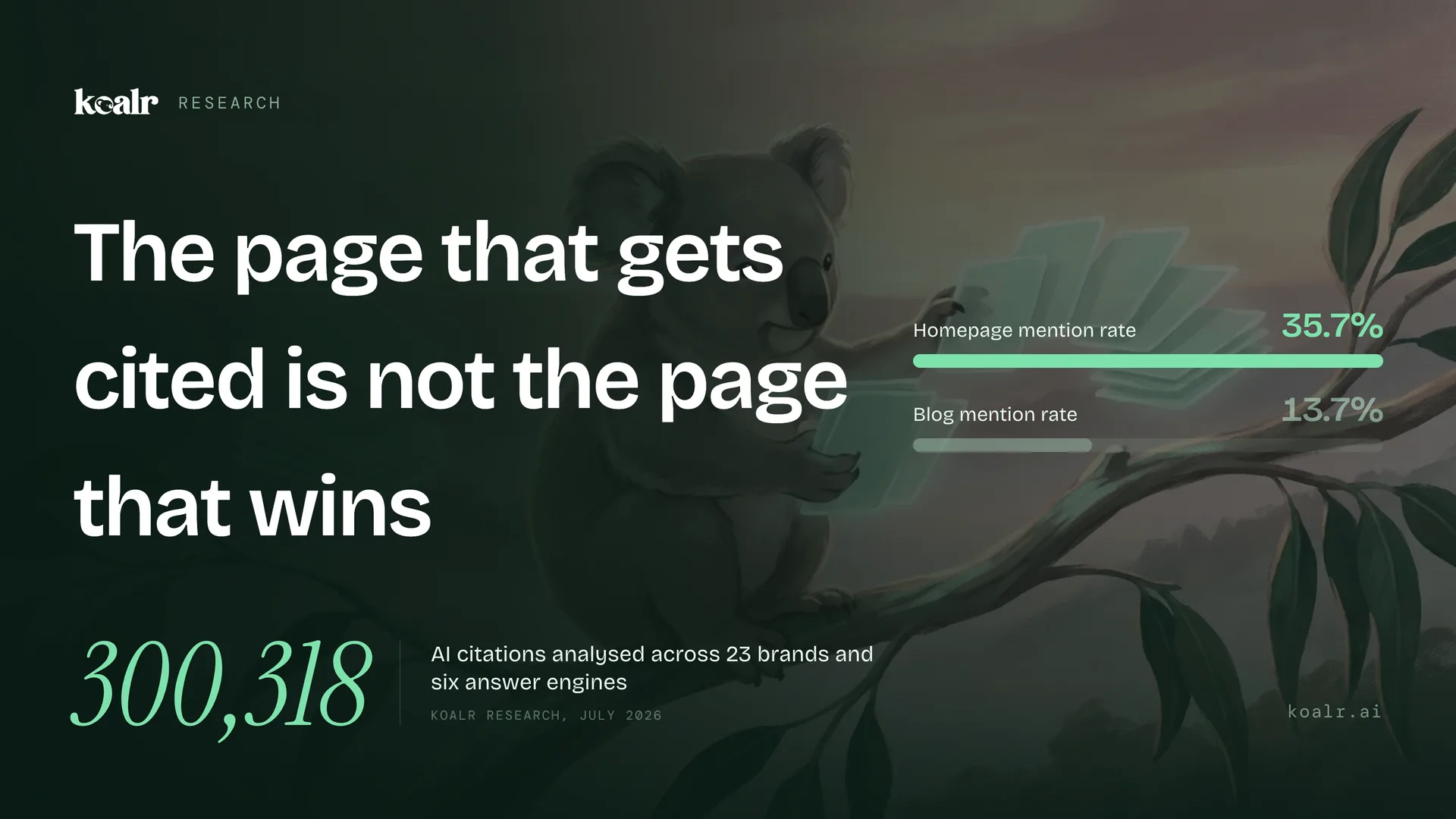
A citation and a recommendation are not the same event, and the page types that earn one are not the page types that earn the other. We looked at 300,318 citations that six AI answer engines actually returned across 23 brands, and the split is wide enough to change where you spend your next month.
What we measured
Koalr runs real buyer prompts against live AI engines on a schedule and records every source each engine returns. This study covers 300,318 citations collected across 23 brands and six citation-returning engines: ChatGPT, Microsoft Copilot, Perplexity, Gemini, Google AI Mode and Google AI Overviews.
For the page-type analysis we used the 295,746 citations that resolve to a classifiable URL. Every page was bucketed by URL shape rather than by what the page claims to be, so a listicle is a listicle whether or not its author called it one.
Two measures matter throughout:
- Citations per URL. How often engines pull a page in as a source.
- Mention rate. How often a citation coincides with the tracked brand actually being named in the answer.
The second one is the one buyers care about, and it is the one most GEO advice leaves out.
Which page types actually get cited?
Citations per URL vary less than expected. Mention rate varies enormously.
| Page type | Citations/URL | Mention rate |
|---|---|---|
| Homepage | 9.8 | 35.7% |
| Product or feature page | 9.5 | 37.1% |
| Listicle (best/top N) | 9.0 | 14.1% |
| Blog page | 8.0 | 13.7% |
| Pricing page | 7.3 | 33.8% |
| Guide | 6.6 | 20.3% |
| Question-style page | 6.4 | 19.4% |
| How-to | 6.4 | 13.2% |
| Alternatives page | 5.1 | 3.1% |
| Comparison (X vs Y) | 4.5 | 23.5% |
Blog pages and homepages sit within two citations per URL of each other. Their mention rates differ by a factor of two and a half.
The reading: blog content teaches an engine about a category, and money pages teach it about a company. When someone asks "what is generative engine optimization", an engine reaches for explanatory content. When someone asks "which tool should I use", it reaches for the pages that describe products, and it names the products it finds there.
Alternatives pages deserve a specific warning. They are cheap to mass-produce and widely recommended, and at a 3.1% mention rate they were the weakest archetype in the entire dataset.
Do the engines agree with each other?
No, and this is the finding with the most practical consequence. Here is where each engine's citations came from, for two page types.
ChatGPT draws about a third of its citations from homepages and roughly one in twenty from blog pages. Google AI Overviews and AI Mode are close to the mirror image. Question-style pages and how-tos show the same pattern even more strongly: those two Google surfaces together account for 55 to 58% of citations for that content.
Where do brand mentions actually come from?
Mention conversion by source type is the most lopsided table in the study.
| Source type | Citations | Mention rate |
|---|---|---|
| Academic | 817 | 68.9% |
| Reference (wiki-like) | 7,047 | 65.1% |
| Directory | 19,068 | 64.6% |
| Review site | 4,211 | 62.8% |
| Marketplace | 8,780 | 57.7% |
| Forum | 858 | 39.0% |
| 2,794 | 37.7% | |
| Company website | 229,651 | 36.6% |
| Social media | 6,843 | 31.3% |
| News | 1,543 | 16.4% |
| Video | 4,187 | 15.8% |
| Blog | 1,619 | 5.2% |
A citation from a directory is roughly twelve times more likely to coincide with the brand being named than a citation from a blog. Getting listed and reviewed is not a nice-to-have alongside content: on this data it is the higher-yield activity of the two, and it needs no content engine at all.
Note also that company websites account for 229,208 of the 300,318 citations, about 76%. The category is heavily self-referential. Engines have relatively little independent editorial to draw on, which is why vendor pages carry so much of the load, and why the non-vendor 24% is fought over by comparatively few players.
Does URL shape matter?
More than it should. Slug length correlates with both measures, and the relationship is monotonic.
| Slug length | URLs | Citations/URL | Mention rate |
|---|---|---|---|
| 1 to 3 words | 15,819 | 9.6 | 48.3% |
| 4 to 6 words | 8,577 | 6.9 | 29.8% |
| 7 to 9 words | 3,675 | 6.0 | 25.4% |
| 10+ words | 3,104 | 5.6 | 19.5% |
Path depth behaves the same way. Depth one to three averages 7.9 to 8.6 citations per URL; past depth seven it falls below 4.0.
Some of this is confounding rather than causation. Homepages have no slug at all and perform well, and important pages tend to sit near the root. But the gradient holds inside the blog bucket too, and a keyword-stuffed slug is free to avoid.
On titles, one signal stood out: pages whose title contains the word "best" earned 10.6 citations per URL, the highest of any title pattern tested, across 2,810 URLs.
See where your brand shows up in AI search
Enter your website and get your AI Visibility Score across 7 engines. First score in under 5 minutes, no setup.
Methodology
Citations were collected by running real buyer prompts against live AI engines on a recurring schedule between 2026 and 2026-07-30, and recording every source URL each engine returned in its answer. No prompts were simulated and no citations were inferred from rankings.
Page types were assigned from URL structure using fixed patterns, so classification does not depend on the publisher's own labelling. Buckets overlap by design: a page at /blog/best-ai-tools counts as both a blog page and a listicle.
Mention rate is the share of a page type's citations that occurred in an answer where the tracked brand was also named. It measures co-occurrence, not causation. A page can be cited in an answer that names the brand for reasons unrelated to that page.
Limitations
Worth stating plainly, because they bound what you should conclude.
- The engines are not evenly represented. Google AI Overviews contributed 70,281 citations and Gemini 30,050. Cross-engine comparisons are shares of each engine's own citations, which handles this, but absolute counts do not.
- Claude is absent from the citation counts. It is tracked for brand mentions, but it does not return citations in a comparable form, so it is excluded from this analysis rather than under-counted in it.
- Own-domain page types have small samples. Restricting to pages on a tracked brand's own site leaves 44 homepages but only four blog URLs. The own-domain figures are directionally striking and statistically thin, so this study leads on the all-domain numbers, which run to thousands of URLs per bucket.
- Twenty-three brands is not the whole web. They skew toward B2B software and marketing categories. Consumer retail or local services may well behave differently.
- Mention rate is co-occurrence. See the methodology note above.
What we would do with this
Three things, in order.
Treat the homepage and product pages as content, not furniture. They are where mentions concentrate and where ChatGPT looks first, and most companies ship them once and never revisit them.
Get listed. Directories, review sites and marketplaces convert citations into brand mentions at ten to twelve times the rate of blog content, and placement is a one-off effort rather than a publishing commitment.
Keep publishing, but measure it correctly. Blog content earns category citations. Judging it on brand mentions will make a working channel look broken. For the related question of which specific pages engines pull from, see which pages AI engines cite when they mention your brand, and for finding where rivals are cited and you are not, see how to find which AI engines are citing your competitors.
Frequently asked questions
300,318 citations collected across 23 brands and six citation-returning AI engines: ChatGPT, Microsoft Copilot, Perplexity, Gemini, Google AI Mode and Google AI Overviews. The page-type analysis covers the 295,746 that resolve to a classifiable URL.