

When Google AI Overviews or Claude mention your brand, they attach a source: a specific page the engine pulled a fact, a review or a comparison from. That page is doing the actual work. It can be your own homepage, or it can be a three-year-old Reddit thread, a directory listing with your old address, or a competitor's round-up that ranks you fourth. The mention feels the same either way. The page behind it decides what the buyer actually reads.
Buyer asks: “is [brand] any good for small teams”
[Brand] gets solid reviews for ease of setup, especially from smaller teams. According to a discussion on a user community forum, some users found the free tier limiting once they added more than two collaborators.
The mention is correct, but the citation links to a two-year-old forum thread, not the brand's current pricing page. A buyer who clicks reads outdated plans and an old price.
Most brands never see this happen. They know if they were named. They rarely know which page the engine pointed to when it said so.
What does it mean for AI to cite your brand?
A mention is your brand's name appearing in an answer. A citation is the source link attached to that mention, the page the engine treats as the evidence behind the sentence. Engines can name you with no citation at all, cite your own site, or cite someone else's page that happens to talk about you. Each one lands differently with the buyer reading it.
A citation to your own pricing page reinforces what you actually sell today. A citation to an old forum post or a stale directory listing can hand the buyer a wrong plan, a retired feature or a price you changed a year ago. The mention count looks identical in both cases. Only the source tells you which one you got.
Where do AI engines actually pull your citations from?
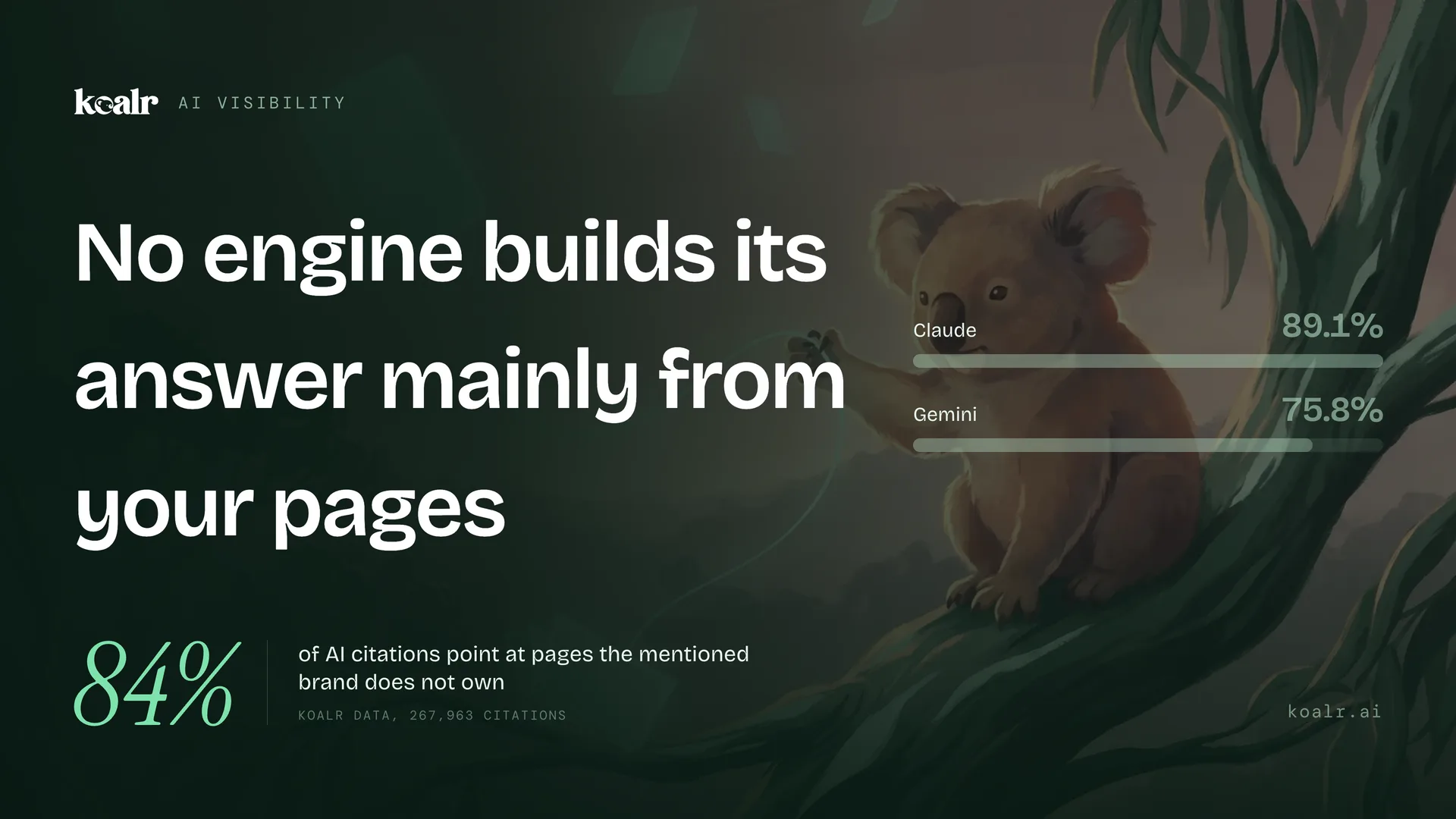
Engines cite whatever page best answers the question, and that is rarely limited to your own website. We pulled every citation Koalr has ever recorded to measure it: 267,963 citations collected while tracking buyer questions across 16 brand categories. 224,329 of them, 84%, pointed at pages the brand does not own. The full top-ten table is below, and none of it is under your direct control unless you know it is happening.
That is a different problem from being absent. You can be named accurately by a page that is wrong about your pricing, or accurately by a page you have never seen. Either way, you find out the same way: by looking at the actual source, not just the mention.
What most teams assume gets cited
- Our homepage or product page
- Whatever ranks first on Google
- Nothing, since we don't track this
- The same source every time
What a citation source check usually shows
- A mix of owned pages and third-party ones
- A forum thread or review site Google doesn't rank highly
- A different source per engine, sometimes per prompt
- At least one page with outdated pricing or a retired feature
The 5 most-cited off-page sources, ranked by Koalr data
This ranking comes from 267,963 citations recorded while Koalr tracked real buyer questions across 16 brand categories. We ranked each domain by how consistently AI engines cite it across every category, rather than by raw volume, so the list holds whatever market you sell in. The top two appear in all 16.
| # | Source | Why engines lean on it | Cited most by |
|---|---|---|---|
| 1 | YouTube | Reviews and walkthroughs with transcripts engines can quote. | Google AI Overviews and AI Mode, then Perplexity |
| 2 | Threads read as unfiltered consensus from real buyers. | Every engine, and the only one of the five that ChatGPT cites | |
| 3 | Pages and groups double as identity checks and local activity signals. | Google's AI surfaces and Perplexity | |
| 4 | Company pages act as the canonical B2B record. | Google's AI surfaces and Perplexity | |
| 5 | Profiles prove a brand is current and active, especially for consumer categories. | Google's AI surfaces |
Each engine also has a favourite. Ask which single off-page source every engine cites most and the answers split three ways:
Three camps, then. Google's surfaces and Perplexity reach for YouTube first. ChatGPT and Gemini reach for Reddit, a pattern consistent with the content deals both companies signed with it. And the outliers tell their own stories: Copilot leans on statistics aggregators like Zipdo, the same citable-numbers pattern we flag below, while Claude cites mainstream platforms so rarely that no favourite emerges from our data at all. If one engine matters most to your buyers, its favourite source is where your off-page effort pays first.
That 84% holds across every engine, from Gemini at 75.8% to Claude at 89.1%. No engine builds its answers mainly from brand-owned pages.
Two things in this data surprised us. Wikipedia, the source most often assumed to dominate AI answers, does not make the top 20 for buyer questions: engines reach for it on encyclopedic queries, and buyer prompts are not encyclopedic. And a cluster of statistics aggregator sites, zipdo.co, worldmetrics.org and gitnux.org among them, earns citations in more than half of our categories. Engines hunt for citable numbers, and pages built from clearly-stated statistics keep winning that hunt. If your category has no statistics page yet, that is an open seat.
The practical reading: treat your brand's presence on YouTube, Reddit and the big profile platforms as citation inventory. Engines already draw on it, with you or without you.
How do you see your own citation sources?
Checking this by hand means running your brand name through each engine separately and reading every answer for a link. Koalr does the same check across every tracked prompt and all seven engines at once, and shows you the exact page behind every citation.
- 1
Run a scan on your domain
Koalr sends the real buyer questions from your category, 25 to 50 per site, to ChatGPT, Claude, Gemini, Perplexity, Microsoft Copilot, Google AI Overviews and Google AI Mode.
- 2
Open Sources for any hit
Every mention of your brand shows the exact page the engine cited, or flags that it named you with no source attached.
- 3
Sort the good sources from the weak ones
See which citations point at pages you control, which point at outdated third-party content, and which questions still cite a competitor instead.
See where your brand shows up in AI search
Enter your website and get your AI Visibility Score across 7 engines. First score in under 5 minutes, no setup.
What do you do when the source is wrong, weak or not yours?
Fix the facts first if the citation is accurate about your brand but stale, since an out-of-date price or a retired feature on a page an engine already trusts is the fastest thing to correct: update the page directly, or ask the site that hosts it to update the listing.
Strengthen the page if the source is thin but on-topic, since engines cite whatever answers the question best. A directory listing or an old comparison post often earns the citation only because nothing more current and more specific exists yet. A sharper page on the same question, published on a site the engine already trusts, gives it a better source to quote instead.
Go where the citation already lives if the source is a forum, a review site or a video you do not control. That is the same problem Koalr's guide on getting cited through content you don't own covers in more depth: the fix is rarely a new page on your own site, it's a comment, an answer or a mention placed inside the third-party page the engine is already reading.
Treat competitor citations as the benchmark, not just your own. If a rival's page keeps earning the citation for a question you should own, find the exact prompts where that is happening before you decide what to write next.
Start checking your citation sources
You cannot fix a source you have not seen. Run a free scan at koalr.ai and see the exact pages ChatGPT, Gemini, Claude and five other engines cite when they mention you, not just whether they named you. Questions go to hello@koalr.ai.
Frequently asked questions
A mention is your brand's name appearing in an AI answer. A citation is the source link the engine attaches to that mention, the specific page it treats as the evidence. Engines can mention a brand with no citation, or cite a page that says something outdated.