

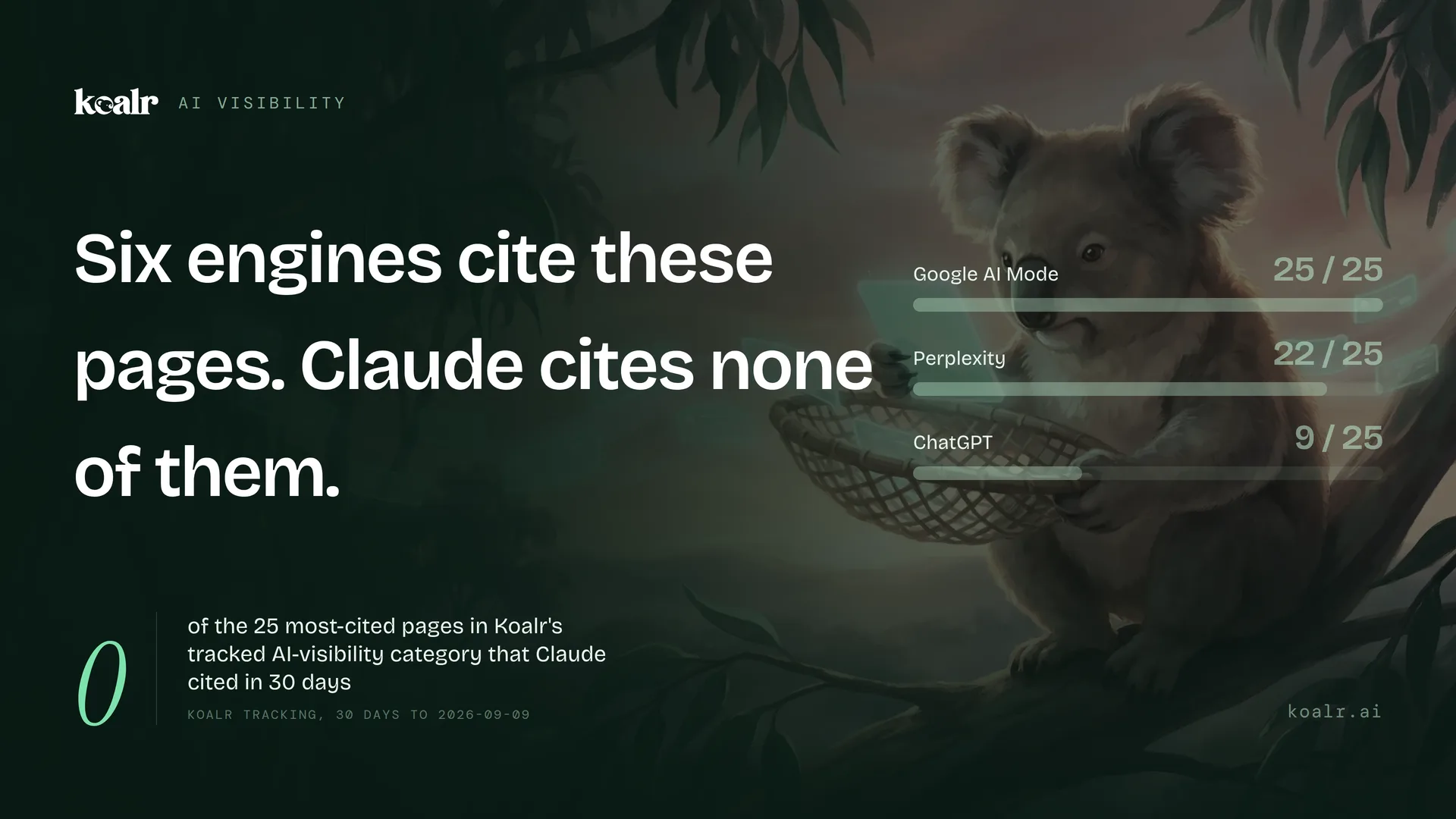
Koalr tracks the AI-visibility-tool category the same way it tracks any category: real buyer prompts, run on a schedule, across all seven engines. Twenty-five pages currently earn enough citations across that cluster to matter. Six of the seven tracked engines cite a meaningful share of them. The seventh, Claude, cited none of the twenty-five in the last 30 days.
Zero is a different kind of number than "slowest of seven." Copilot's 10 of 25 and ChatGPT's 9 of 25 are both well short of Google's three surfaces, and neither one is zero. Ask Claude the kind of question this cluster is built from, and the answer differs in kind, not just in count.
Buyer asks: “what's the best ai visibility tracking tool for monitoring brand mentions across chatgpt and gemini”
I don't have a current, verified comparison of specific AI-visibility tracking products to point you to. Vendor claims in this space change quickly, so I'd suggest checking a few providers' own sites directly rather than relying on a summary from me.
Six of the seven engines Koalr tracks answer this category of question with a shortlist of named tools and a linked source. Tracked on the same prompts over the same 30 days, Claude is the one that consistently does not.
What we measured
Koalr runs a set of real buyer prompts in the AI-visibility and GEO-tool category across ChatGPT, Claude, Gemini, Perplexity, Microsoft Copilot, Google AI Overviews and Google AI Mode, on a recurring schedule. Over the 30 days to 2026-09-09, that tracking surfaced 25 pages, on other tools' own domains, that earn real citation volume across the cluster: enough prompts, cited often enough, to count as pages the category actually rewards.
For each of those 25 pages we checked one thing: did each of the seven tracked engines cite it at all inside the window. Not how often, not how prominently. Presence, page by page, engine by engine.
Google's three surfaces cite almost everything in this category
Google AI Mode, Google AI Overview and Gemini are three separate products with three separate answer pipelines, and on this cluster they behave almost identically: 25, 24 and 23 of the 25 pages respectively. Perplexity sits close behind at 22. For a buyer typing "best ai visibility tool" or its variants into any of those four surfaces, nearly every page in this set is in reach of the answer.
Copilot and ChatGPT are a real step down, 10 and 9 of 25, and that gap is worth its own note: neither is close to Claude's zero, but neither is close to Google's near-total coverage either. The category splits into three tiers, not two, and Claude is its own tier below all of them.
Why Claude's citation behavior looks different, not just smaller
Anthropic publishes a dedicated crawler for citations, Claude-SearchBot, kept separate from ClaudeBot, which trains the model, and Claude-User, which fetches a page only when someone in a chat asks Claude to open it. The feature exists. Our piece on AI crawlers covers the full three-bot split: three different jobs, and blocking the wrong one changes nothing about whether you get cited.
The difference is upstream of crawling. Anthropic's own documentation for the web search tool describes Claude deciding, per query, whether a question needs a live search or whether its training data already answers it well enough. When Claude does search, it queries Brave Search and cites what it retrieves. When it decides a search isn't warranted, no search runs and nothing gets cited, which is closer to what the example above shows: a hedge toward the reader checking primary sources directly, rather than a shortlist assembled from a search Claude chose not to run.
The other six engines default the other way on a comparison prompt like this one. Google's three surfaces and Perplexity are built to retrieve first and answer from what comes back. ChatGPT and Copilot sit between the two postures, which is consistent with landing at 9 and 10 of 25 rather than at either extreme.
What this means if you're building for citations
The instinct is to treat Claude as one more engine to optimize for with the same structural moves that work everywhere else: comparison tables, question-format headings, a fresh date. None of that helps if Claude never runs the search that would find the page. The lever isn't better structure, it's whether the question Claude receives is one it decides is worth searching for at all, which is a property of the prompt and Claude's own judgement, not of your page.
That doesn't make the other six engines less worth building for. Four of them are citing 22 to 25 of the 25 pages in this category, which is most of the addressable citation volume in this cluster sitting behind normal GEO work: structured pages, clear entity naming, tables in the first screen. The source-type breakdown behind what actually converts to a citation still applies to Google, Perplexity, Copilot and ChatGPT here. Claude is the one engine in Koalr's seven where that playbook is answering the wrong question.
See where your brand shows up in AI search
Enter your website and get your AI Visibility Score across 7 engines. First score in under 5 minutes, no setup.
Methodology
Prompts: a live cluster of real buyer questions in the AI-visibility and GEO-tool category, tracked by Koalr across ChatGPT, Claude, Gemini, Perplexity, Microsoft Copilot, Google AI Overviews and Google AI Mode. Window: 30 days to 2026-09-09. Sample: the 25 pages, across other tools' own domains, that earned citation volume across the cluster in that window. Measure: whether each of the seven tracked engines cited each page at all inside the window, a binary presence count rather than a citation-volume ranking.
Limitations
This is one category, tracked over one 30-day window. It measures presence, not volume or prominence, so a page cited once by an engine counts the same as a page cited fifty times. A broader category, or a longer window, could show a different split, and Claude's own willingness to run a search is a model behavior that can change release to release. Worth re-checking before anyone treats a zero this clean as permanent.
Frequently asked questions
Frequently asked questions
Yes. Anthropic's web search tool has Claude decide, per query, whether a question needs a live search or whether its training data is sufficient. When it does search, every result is cited back to its source. The zero in this piece is specific to one 30-day window in one competitive category, where Claude consistently judged that a live search was not warranted, not a claim that Claude never cites anything.