

A homepage, a pricing page, a how-to guide and a "best of" listicle are not competing for the same citation. Koalr's tracking shows each of the nine page archetypes it measures earns a different slice of its citations from each of the six AI engines that attach a retrievable source to an answer. Build the wrong one for the engine your buyers actually use and the content can be genuinely good and still never get picked up.
Which page type does each AI engine actually cite?
Koalr classifies every citation it records into one of nine page archetypes and reports what share of each archetype's citations came from which engine. Six of the seven engines Koalr tracks attach a retrievable source to most answers: ChatGPT, Microsoft Copilot, Perplexity, Gemini, Google AI Overview and Google AI Mode. Claude sits outside this table, because it rarely surfaces a source link the same way in ordinary use.
| Archetype | ChatGPT | Copilot | Perplexity | Gemini | AI Mode | AI Overview |
|---|---|---|---|---|---|---|
| Homepage | 34.1% | 30.0% | 10.9% | 5.6% | 8.2% | 9.3% |
| Product / feature page | 11.0% | 4.0% | 21.2% | 10.5% | 23.7% | 24.4% |
| Pricing / cost page | 14.8% | 12.3% | 24.1% | 4.0% | 21.2% | 22.6% |
| Blog path | 5.2% | 12.1% | 17.3% | 12.8% | 24.0% | 26.1% |
| Listicle (best / top N) | 4.4% | 19.7% | 17.7% | 11.7% | 21.9% | 23.4% |
| Question slug | 7.8% | 3.9% | 19.8% | 7.2% | 27.2% | 29.8% |
| How-to | 6.9% | 5.6% | 17.4% | 7.8% | 27.8% | 28.9% |
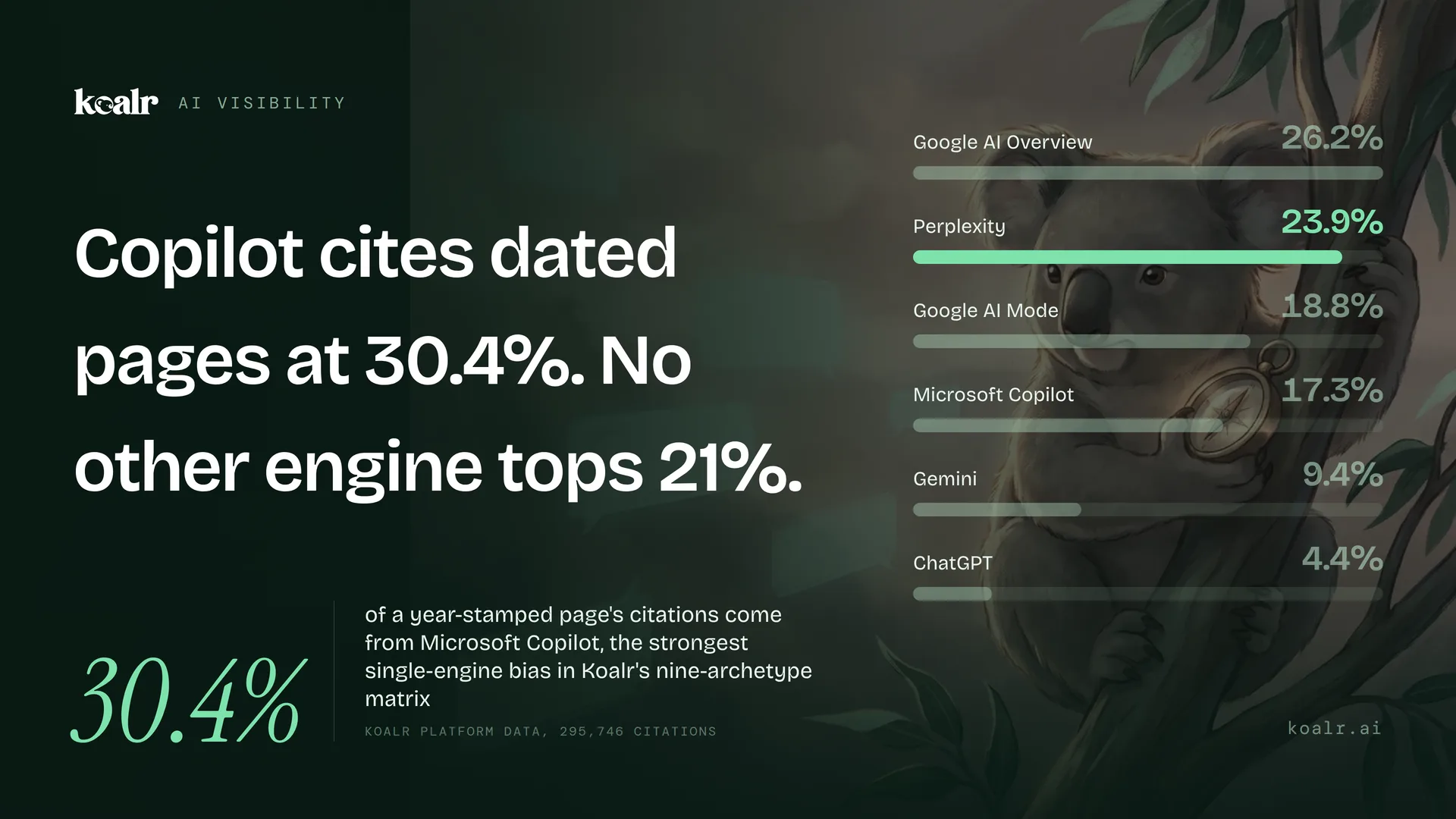
| Year-stamped title | 7.2% | 30.4% | 13.5% | 7.9% | 18.7% | 21.1% |
| Alternatives page | 4.4% | 17.3% | 23.9% | 9.4% | 18.8% | 26.2% |
Read each row as a share of that archetype's own citations, not a share of the whole engine. Homepages that get cited at all draw 34.1% of their citation volume from ChatGPT, the highest single figure in the table. That does not mean ChatGPT prefers homepages to everything else; it means that when a homepage does earn a citation, ChatGPT is disproportionately the engine doing the citing.
Buyer asks: “best help desk software for a 20-person support team (2026)”
For a 20-person team, HelpScout and Freshdesk come up most often in current comparisons. HelpScout suits teams that want a shared inbox feel, while Freshdesk offers more automation out of the box for a similar headcount.
Copilot pulled the source from a page titled '9 Best Help Desk Tools for Small Teams (2026)', not from either vendor's own homepage. A dated, structured list beat two homepages that answer the same question.
ChatGPT and Copilot both reward you for having a strong front door
ChatGPT and Copilot are the two engines most willing to cite a homepage, and a fuller breakdown of exactly how far ahead ChatGPT runs on that measure is in our study of 300,318 AI citations. What the two engines do not share is the second thing each one reaches for. ChatGPT's next-most-cited archetype after homepages is pricing, a page that states a number plainly rather than asking a reader to dig for it. Copilot's is the dated listicle covered below, a habit closer to how it handles news and current-events queries than to how it treats a static product page.
The practical read for a team whose buyers mostly live in ChatGPT or Copilot: a homepage and a pricing page that state what the product is and what it costs, in plain server-rendered text, do more for citation odds than another blog post will. The full case for why pricing has to be plain text, not a client-rendered widget, is here.
Google's AI surfaces want the opposite: a page built to answer one question
Flip to the last two columns and the pattern reverses almost row for row. Question-slug pages, how-to guides and ordinary blog posts each send more than a quarter of their citations to Google AI Overview and AI Mode combined, while homepages barely register for either surface. How Google AI Mode decides what to cite covers the mechanics behind that gap in more depth than a table can.
The instinct this produces in most content teams is to build one page and hope it serves both audiences. The matrix argues against that. A homepage that also tries to read like a how-to guide usually does neither job well, and a how-to guide padded with homepage-style brand language buries the direct answer the question-slug archetype needs in its first 40 to 60 words. Pick the job before picking the format.
See where your brand shows up in AI search
Enter your website and get your AI Visibility Score across 7 engines. First score in under 5 minutes, no setup.
Perplexity still finds value in the archetype everyone else has given up on
Alternatives pages are the weakest archetype Koalr tracks by almost every other measure: the lowest brand-mention rate in the dataset and among the lowest citations per URL. Most GEO advice, including Koalr's own, says deprioritise them. Perplexity did not get that memo. It draws 23.9% of alternatives pages' total citations, a materially higher share than Gemini (9.4%) or ChatGPT (4.4%) manage on the same archetype, and not far off what it draws from pricing pages.
The likely reason is structural rather than editorial. Perplexity rebuilds its evidence from scratch on every question rather than working from a standing index, and an alternatives page is, by construction, a dense list of named competitors answering a comparison question directly. That is exactly the shape Perplexity's retrieval seems to reward, even when the underlying page is thin. It is a reason to keep one well-built alternatives page in reserve if Perplexity carries real weight for your buyers, not a reason to build five of them.
Copilot has a weakness none of the other five share
Put a year in a title and Copilot cites it at more than double the rate of any engine except itself against every other archetype in this table. Microsoft's own Bing index has always leaned on freshness signals harder than the search engines it competes with, and Copilot appears to have inherited the habit wholesale. If a page is genuinely current this year, and your buyers spend real time in Copilot, the year belongs in the title. If the content has not changed since last year, adding one anyway is the auto-stamped freshness trick that gets a domain's dates discounted at scale.
Which page type should you actually build first?
None of this is a checklist to work through top to bottom. It is a routing decision, and the input is which engine your buyers actually use, not which archetype looks most impressive on a roadmap.
- Buyers mostly ask ChatGPT or Copilot. Fix the homepage and the pricing page before writing anything else. A dated listicle is worth a slot for Copilot specifically, not as a general-purpose asset.
- Buyers mostly ask Google, through AI Overview or AI Mode. A cluster of how-to and question-slug pages, each answering one question plainly in its opening sentence, will outperform a redesigned homepage by a wide margin.
- Buyers mostly ask Perplexity. Product and pricing pages carry the most weight, with a single well-built alternatives page as a legitimate secondary bet, not a default.
- Buyers are spread across several engines. Build in the order above, because homepage and pricing fixes are cheap relative to a new content cluster, then add the Google-facing content once the front door is solid.
The one thing every row of the matrix agrees on: no single page type wins across all six engines. Betting a content budget on one archetype means betting on one engine's buyers, whether or not that was the plan.
Frequently asked questions
The homepage, by a wide margin. ChatGPT draws a larger share of its citations from homepages than any of the other five engines Koalr measures on this table, well ahead of its next-most-cited archetype, pricing pages. The full figures are in our citation study.