

Ranking in Google AI Overviews means becoming one of the four to six sources the summary cites at the bottom, not winning the top blue link. Google draws that shortlist from pages that already rank organically for the query, answer it directly in the opening sentences, and are structured so a chunk can be lifted whole.
Buyer asks: “how to get cited in ai overviews”
To improve your odds of being cited in an AI Overview, make sure the page already ranks well organically, answer the specific question in the first few sentences, and structure the content with clear headings, lists or tables rather than long unbroken paragraphs. Schema markup and consistent entity signals also help retrieval match the page to the query.
Five links sit at the bottom of the summary. Every one of them already ranked in the top ten organically for this exact phrase before the overview existed.
That is a fair summary of what most SEO guides currently say, and none of it is wrong. It is also generic enough to apply to any page in any category, which is the problem: it tells you what to do without showing which of it moves a citation, and by how much. Koalr's own citation data, measured across real buyer questions, breaks the vague version down into specifics.
What is an AI Overview?
An AI Overview is Google's generated summary at the top of search results, built by retrieving a handful of pages for the query and synthesising an answer from them, with source links attached below the text. It sits above the ranked list of blue links rather than replacing it.
The practical difference from ranking well is that the overview curates from an already-ranked set rather than creating a new one. A page has to clear the normal bar before Google will consider quoting it, then clear a second bar to become one of the handful cited. Most of what follows is about that second bar, because the first one is ordinary SEO and this piece is not about ordinary SEO.
Does a page need to rank organically first?
Yes, on every query Koalr has checked in this category. AI Overviews on informational queries draw their citations from pages already sitting inside the standard organic results, typically the top ten to twenty. A page with no organic position for the query is not inside the set the summary gets built from.
That is the uncomfortable implication for anyone hoping AI Overviews are a shortcut around ranking. They are not. Structure earns the citation once a page is already competitive; it does not substitute for being competitive. Everything below assumes the organic position exists or is realistically achievable, because none of it works without that first.
Where the citations come from
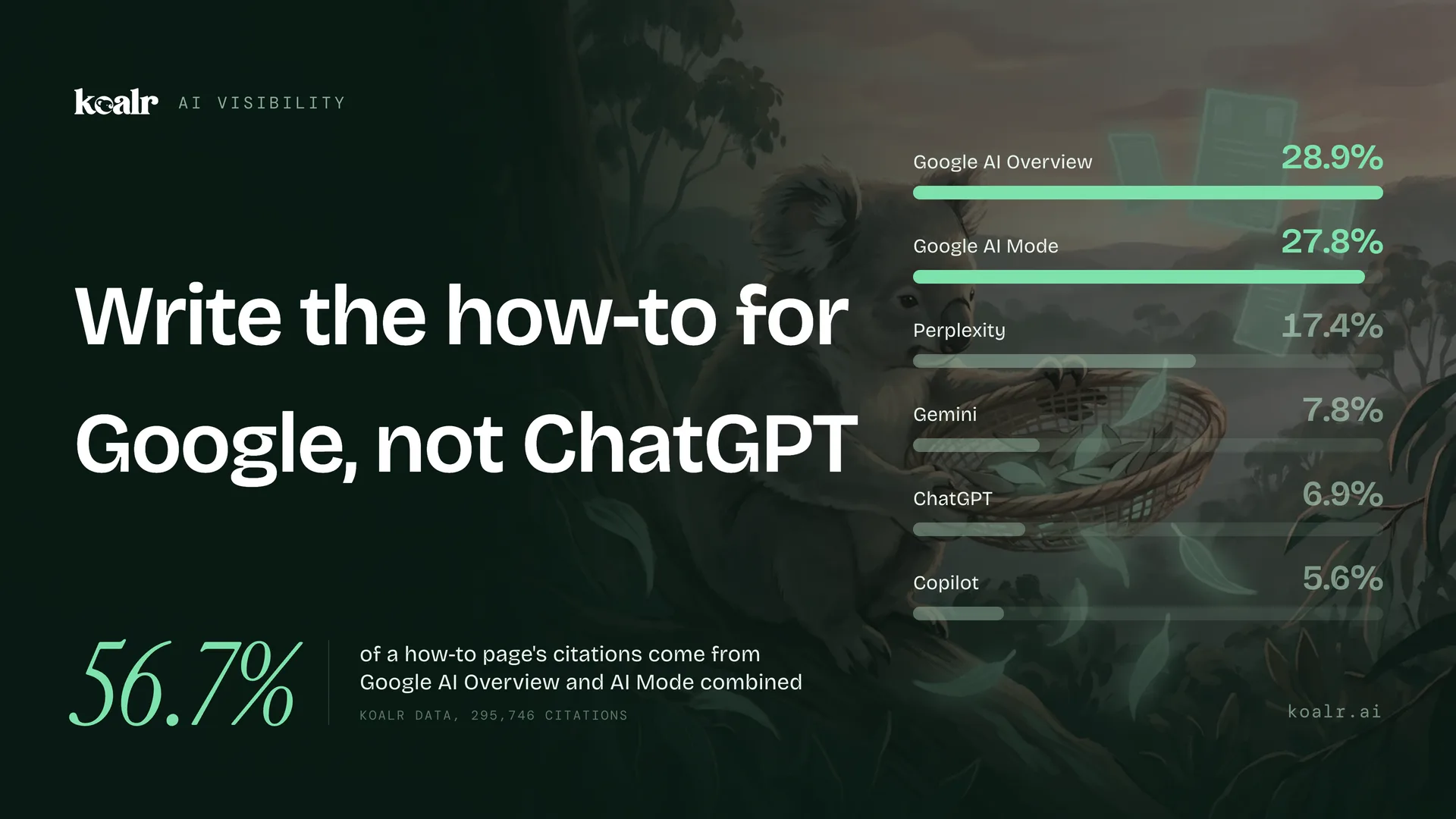
Add Google's two AI surfaces together and they account for 56.7% of every citation a how-to page earns, in Koalr's dataset of 295,746 citations across 23 projects and six engines: 28.9% from AI Overview and 27.8% from AI Mode. ChatGPT, by contrast, pulls only 6.9% of its citations from this page type.
See where your brand shows up in AI search
Enter your website and get your AI Visibility Score across 7 engines. First score in under 5 minutes, no setup.
Structure the page for extraction, not just for readers
Google's retrieval system does not read a page top to bottom the way a person does. It scores chunks, usually the text under one heading, independently, and pulls the highest-scoring ones into the summary. A page that reads well but buries its answer in the third paragraph of a long introduction is invisible to that process, however well it ranks.
- 1
Answer before you explain
Put the direct answer to the query in the first 40 to 60 words under the heading. Context, a restated question, a scene-setting sentence, all of it sits after the answer or gets cut.
- 2
Match the heading to the query
Use the buyer's own phrasing in the H2, close to verbatim. Retrieval matches on the heading as much as the body, so a heading like 'Overview' or 'Getting started' gives the system nothing to match against.
- 3
Give it a shape a chunk can survive
A table, a numbered list or a short FAQ block extracts cleanly. A dense paragraph covering three ideas at once usually gets trimmed to its first sentence, or skipped for a cleaner competing chunk.
Title, slug and schema choices that move the needle
Three formatting choices show a measurable effect in Koalr's citation data, and none of them are specific to Google's AI surfaces. They compound with everything above rather than replacing it.
| Choice | What the data shows | Why it matters here |
|---|---|---|
| Slug length | 1-3 word slugs earn 9.6 citations per URL and a 48.3% mention rate; 10+ word slugs earn 5.6 and 19.5% | A long, keyword-stuffed slug is a handicap before the content is even read |
| Question-format titles | Below average on raw citations overall at 6.6 per URL, but the title shape that skews hardest to Google's two AI surfaces | Use deliberately when AI Overview and AI Mode are the actual target, not as a default |
| FAQ schema | Must match questions rendered visibly on the page | Schema for questions nobody can read is a spam signal, not a shortcut |
None of these substitute for the organic ranking and the extractable structure above. They are the margin, not the floor.
Common mistakes that keep a ranking page out
The most common mistake is treating an AI Overview citation as a bonus that arrives automatically once a page ranks. It does not. A page can hold position three and still never get cited, usually because the answer is buried, the page is one long paragraph, or five competitors already answer the same question more directly.
| Mistake | Why it fails | Fix |
|---|---|---|
| Answer buried past the opening | Retrieval weighs the first chunk under a heading most heavily | Move the direct answer to the first sentence, cut the setup |
| One long paragraph covering several points | Nothing chunks cleanly, so nothing extracts cleanly | Split into headed sections, one idea per section |
| Generic heading text | Gives retrieval nothing to match against the query | Rewrite headings in the query's own words |
| No table or list on the page | Prose alone rarely survives extraction for a multi-part answer | Add at least one table or numbered list per major section |
| FAQ schema with no visible FAQ | A spam signal, and against Google's own guidance | Only mark up questions a reader can see |
Where Koalr fits
Search Console shows AI Overview appearances for queries you already track, but not whether your brand is the source cited inside them for the buyer questions that decide a sale. Koalr runs real buyer prompts across the seven engines it tracks, including Google AI Overviews and Google AI Mode, and records which URL got cited for each one.
Restructure a page using the pattern above, then re-run the same prompt two weeks later and check whether the citation moved. That comparison, not the organic ranking, is the actual test: ranking well and being the source at the bottom of the box are related but separate questions, and only one of them is visible in Search Console.
Frequently asked questions
Frequently asked questions
No. Ranking is a precondition, not a guarantee. Google still curates a small set of sources from the pages that already rank, and a page can hold position one or two and be passed over if a lower-ranked page answers the query more directly or in a cleaner structure.
Sources
- Koalr platform data, 295,746 citations across 23 projects and six engines: the how-to archetype's per-engine citation split, the title and slug formatting comparisons, and the schema guidance.
- Google Search Central, developer blog on succeeding in AI-powered search: the baseline recommendation to build content for people, keep pages accessible to crawlers, and provide a genuine page experience, which this piece treats as the entry requirement rather than the differentiator.
- Where does ChatGPT get its information?: why the same structure that wins an AI Overview citation does comparatively little for ChatGPT, and what to build instead if ChatGPT is the target.
- Which pages do AI engines cite when they mention your brand?: the full per-engine source ranking behind the retrieval behaviour described here.
- Prompt tracking: fewer questions, watched properly: how to set up the repeated, dated re-checks this piece recommends before crediting a structural change.