

SEO gets a page ranked on Google. GEO gets a brand named inside the AI-written answer that increasingly sits above that ranking. Neither replaces the other, and asking which is better skips the actual question: they compete for the same limited hours in your week, and right now most teams spend all of them on one.
| SEO | GEO | |
|---|---|---|
| What wins | A ranked position on Google's results page | A named mention inside the answer an engine writes |
| The content that scores | Comprehensive pages that cover a keyword from every angle | A tight, self-contained answer an engine can quote whole |
| The pages that carry it on your own site | Blog and guide content, built for keyword coverage | Homepage, product and pricing pages, the ones engines cite most on your own domain |
| How you'd check progress | Rank position, organic traffic, Search Console | Running your buyers' real questions through each engine and reading who gets named |
| Time to first signal | Weeks to months, tied to crawl and index cycles | Days on engines with live retrieval; consensus across engines builds over months |
Neither column is optional. The split below is about where your next hour of work should go, not which discipline to drop.
What is SEO?
Search engine optimization is the practice of getting a page to rank on Google, Bing or another traditional search engine, so a person scanning a results page finds you among the top links. It rests on crawlability, keyword targeting, backlinks and page speed, tuned to what a ranking algorithm rewards.
What is GEO?
Generative engine optimization is the practice of getting an AI engine such as ChatGPT, Gemini or Perplexity to name and cite your brand inside the answer it writes, instead of ranking a page at all. The full mechanics, including where the term came from and the three jobs GEO splits into, are covered in what generative engine optimization actually means.
Buyer asks: “geo vs seo, which one do I actually need”
SEO and GEO are not competitors. SEO gets your pages ranked in traditional search results, while GEO gets your brand mentioned directly in AI-generated answers from tools like ChatGPT and Google's AI Overviews. Most businesses need both: keep your SEO foundation strong, and layer GEO work such as clear, quotable content and structured data on top.
Notice the answer settles the question in two sentences and moves straight to a recommendation. It never says that the two disciplines are measured on entirely different surfaces, which is the part you need before deciding where the next hour of work goes.
GEO vs SEO: which of your own pages actually earn it
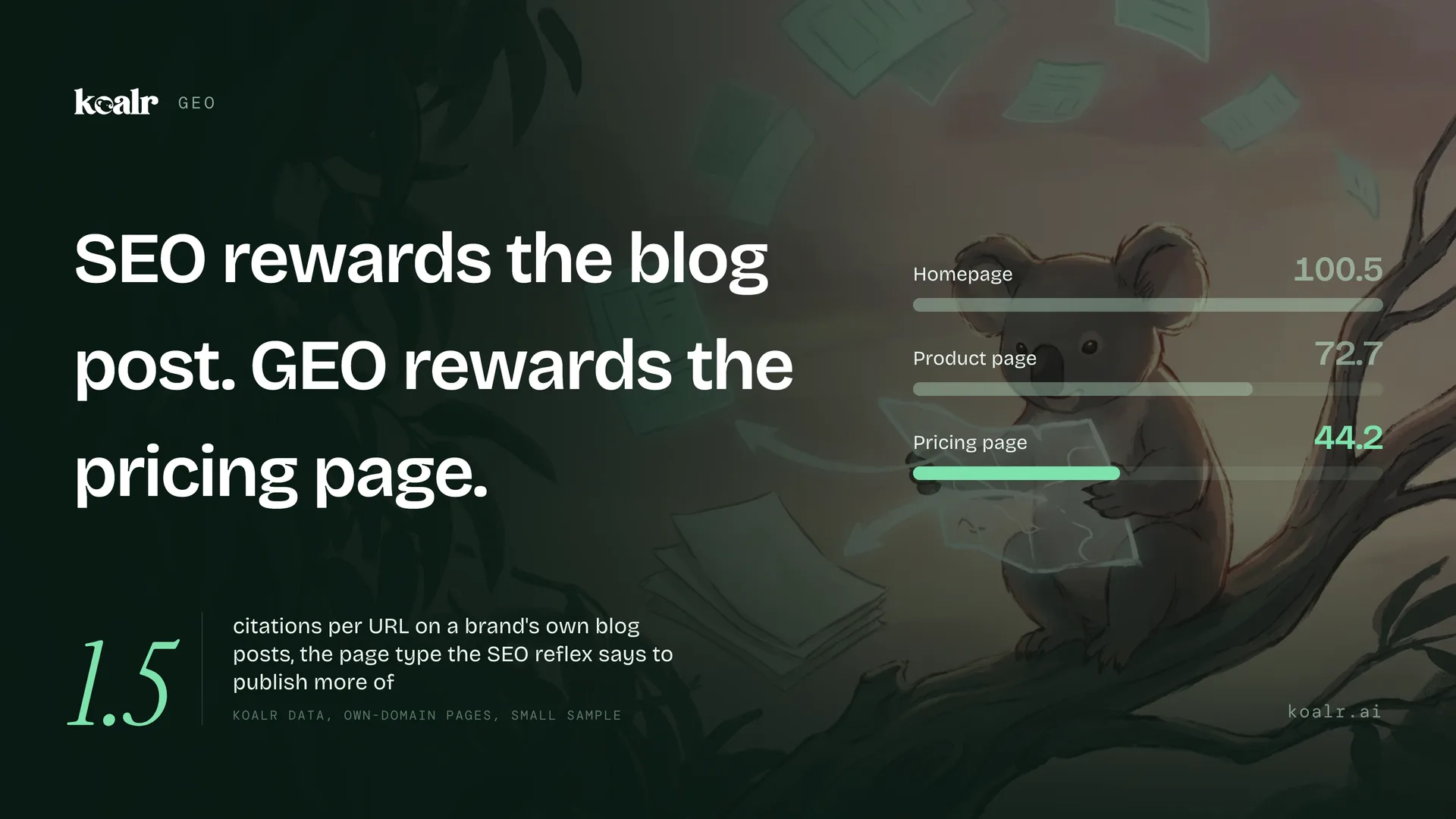
Classic SEO habit says publish more blog content, because more URLs mean more chances to rank. Restrict Koalr's dataset to pages sitting on a tracked brand's own site and that habit does not carry over to GEO. Blog posts earn 1.5 citations per URL. Product pages earn 72.7. Pricing pages earn 44.2, provided the numbers sit in the HTML as plain text rather than behind a script.
Read those as directional rather than precise. The own-domain cut is a small sample, four URLs in the blog bucket against 44 homepages, which is why our citation study leads on the all-domain figures instead. The direction is consistent across both: on all domains, a citation to a homepage coincides with the brand being named 35.7% of the time, against 13.7% for a blog page.
The gap is not an argument against blogging. Category-level citations, the kind that get a brand discovered rather than confirmed once a buyer already knows your name, still come from blog and guide content, and this post is one of them. But if the job in front of you is proving your own brand exists to an engine that already knows to ask about you by name, the SEO reflex of shipping another post is the wrong page to fix first. Rewrite the pricing page instead.
GEO vs SEO: the one lever they both reward
Site depth is the exception. In Koalr's dataset, pages one click from the homepage earn 8.6 citations per URL, two clicks earn 8.1, three clicks earn 7.9, and anything past seven clicks deep collapses to under 4.0. Google's crawlers deprioritize pages buried that deep to protect crawl budget. AI retrieval discounts them for a related reason, a page nothing else links to rarely reads as important source material either.
Keep everything within three path segments and both disciplines benefit from the same fix. A flat sitemap is not a growth hack for either one. It is the floor both stand on.
How do you measure each?
SEO measurement already has a mature toolkit built around a page's position in a list: rank trackers, Search Console, backlink audits. GEO measurement has no equivalent standard yet, so most teams borrow the closest available proxy, running the real questions their buyers ask through each engine on a schedule and recording who gets named.
That is the job Koalr does: real buyer prompts, 25 to 50 per site, run across all seven tracked engines, ChatGPT, Claude, Gemini, Perplexity, Microsoft Copilot, Google AI Overviews and Google AI Mode, condensed into an AI Visibility Score from 0 to 100. How to track your brand in ChatGPT and Gemini covers the manual version of the same check, and what it does and does not tell you.
See where your brand shows up in AI search
Enter your website and get your AI Visibility Score across 7 engines. First score in under 5 minutes, no setup.
Which should you prioritize this quarter?
Choose SEO first if:
- Organic clicks still make up most of your traffic
- The term you're targeting has real commercial intent and a ranking gap you can close
- The page's job is to earn a click, not a mention
Choose GEO first if:
- Buyers in your category are already asking ChatGPT, Gemini or Perplexity before they open Google
- You've watched a competitor get named in an answer where you were absent
- The page in question is your homepage, a product page or pricing, the ones that convert citations into mentions on your own domain
Almost nobody chooses once. GEO sits on top of an SEO foundation you still need, the same crawlable pages and working sitemap either discipline depends on. What changes week to week is where the next hour goes: another blog post chasing a keyword, or a product page rewritten so an engine can quote it whole.
Run a free scan at koalr.ai to see where your own pages already stand across all seven engines, no card required. Questions about the score go to hello@koalr.ai.
Frequently asked questions
No. AI engines still rely on search indexes to find candidate sources, so the crawlability and authority SEO builds remain the entry ticket. GEO adds a second job on top: shaping content so the retrieved page gets quoted and the brand gets named, rather than just ranked.