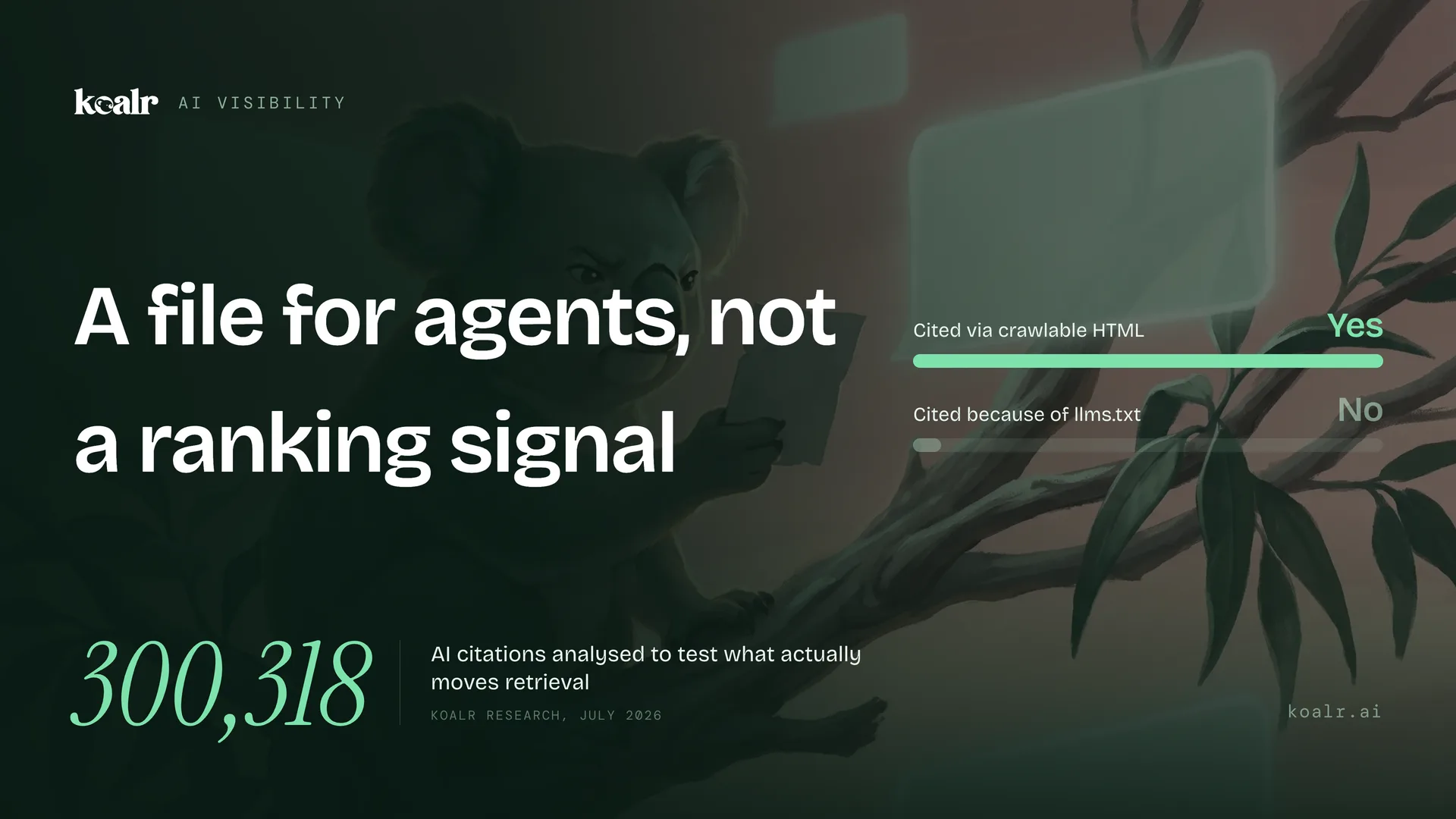
llms.txt is worth having, and it will not move your position in AI Overviews. Both of those are true, and most writing about the file picks one and ignores the other. The useful question is not whether to publish one. It is what job the file actually does, so you know what to expect from it and what to work on instead.
What is llms.txt?
llms.txt is a Markdown file served at the root of a domain, at /llms.txt, listing the pages and resources you would like a language model to prioritise when working with your site. It was proposed by Jeremy Howard of Answer.AI in September 2024, and a growing set of documentation sites and SaaS vendors now publish one.
In structure it sits somewhere between robots.txt and sitemap.xml. robots.txt tells crawlers what they may not fetch. sitemap.xml lists what exists. llms.txt tries to say what matters most, in a format a model can read directly.
The idea is sound. The question is who honours it.
Do the AI search engines use it?
Google has been explicit. Its AI optimisation guidance published on 15 May 2026 tells site owners that llms.txt is not needed for AI Overviews, AI Mode or any other generative AI Search feature. In July 2025, Google's Gary Illyes said Google does not support llms.txt and has no plans to, and John Mueller has compared it to the keywords meta tag.
The other major providers have said less, which is its own kind of answer. As of 2026, OpenAI, Anthropic, Google and Meta have not publicly committed to reading or acting on the file inside their production answer engines.
So if your goal is to appear in more AI Overviews, this file is not the lever. Anyone selling llms.txt generation as an AI search visibility service is selling you something the largest engine has publicly said it ignores.
So what does it genuinely do?
It gives AI agents a curated entry point to your content, and that is a real problem worth solving.
OpenAI, Anthropic, Stripe, Cloudflare and Vercel all publish llms.txt files. They are not doing it to rank. They are doing it so an AI coding agent pointed at their documentation lands on the right pages instead of crawling an entire docs site and guessing. When an agent gives a developer an accurate answer about your API, that is a business outcome.
This is the distinction worth holding onto: agent access and search visibility are different problems.
- Agent access asks whether a machine can reach your content, parse it and find the parts that matter. Crawler permissions, schema, clean HTML and llms.txt all sit here.
- Search visibility asks whether an engine chooses to name and cite you when a buyer asks a question. That is decided by what your pages say and how they are structured, not by a routing file.
Fixing agent access does not guarantee visibility. But an agent that cannot read your site cannot cite it either, which is why the access layer is worth getting right first even though it is not sufficient on its own.
What llms.txt will not do
- Improve your position in Google AI Overviews or AI Mode
- Make ChatGPT or Perplexity start recommending you
- Replace schema, sitemaps or server-rendered HTML
- Give an engine a reason to quote a page it would otherwise skip
What llms.txt does do
- Point AI agents at the documentation pages that matter
- Give a curated entry point to a large or sprawling site
- Sit alongside crawler access and schema as part of agent readiness
- Cost about twenty minutes to publish and do no harm
What actually drives citations?
We run real buyer prompts against live AI engines and record every source returned. Across 300,318 citations from 23 brands and six citation-returning engines, the differences that separate cited pages from uncited ones are structural.
Page type is the strongest single factor. Homepages earn 9.8 citations per URL and product pages 9.5, against 5.1 for alternatives pages. Engines reach for different page shapes depending on the question.
Attribution and schema track with a large difference. On one domain we examined, a section carrying authors, real dates and article schema earned 2.38 citations per page. A larger section on the same domain with none of that earned 0.06. Those sections differ in content quality as well as metadata, so treat it as correlation rather than a clean experiment, but the metadata half is the cheap half.
URL shape shows up too. Slugs of one to three words earned 9.6 citations per URL against 5.6 for slugs of ten or more.
Agent readiness, in priority order
- Confirm AI crawlers are not blocked in robots.txt or at the edge. This one genuinely does make you invisible if it is wrong.
- Serve key content as server-rendered HTML rather than injecting it after load.
- Add Organization, Article and FAQPage schema, and make sure every marked-up question is visible on the page.
- Put a named author and a genuine publication date on anything with a point of view.
- Answer each heading in the first 40 to 60 words underneath it, because that is the chunk an engine lifts.
- Publish an llms.txt. It is twenty minutes, it helps agents navigate, and it is the last item on this list for a reason.
See where your brand shows up in AI search
Enter your website and get your AI Visibility Score across 7 engines. First score in under 5 minutes, no setup.
Should you publish one?
Yes, with accurate expectations. It is cheap, it does no harm, it helps agents that do read it, and if the major engines ever adopt it you are already covered.
What we would not do is treat it as a ranking tactic, pay for it as a standalone AI search service, or let it stand in for the structural work above. Order matters here. Crawler access, schema and page structure decide whether you get cited. llms.txt decides how efficiently an agent that already wants your content can find its way around.
For what does move citations, see publishing more pages does not get you cited and blogs get cited, homepages get recommended.
Frequently asked questions
No. Google's AI optimisation guidance published on 15 May 2026 states that llms.txt is not needed for AI Overviews, AI Mode or any other generative AI Search feature. Google's Gary Illyes said in July 2025 that Google does not support the file and has no plans to, and John Mueller has compared it to the keywords meta tag.