

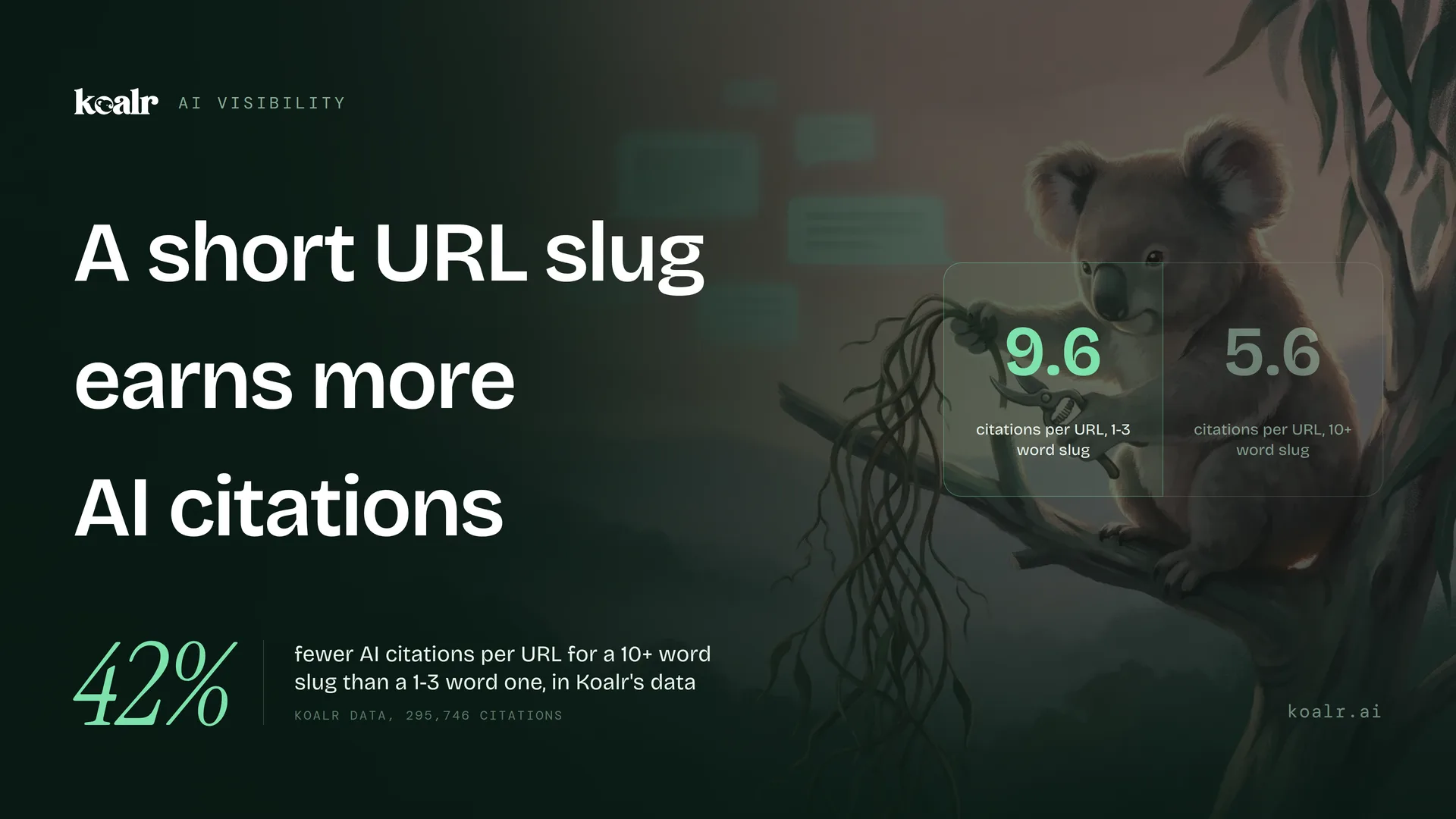
Ask Google whether a short URL ranks better and the answer, from Google itself, is no. Ask the same question about AI citations and Koalr's own data says otherwise: pages with a one-to-three word slug earn 9.6 citations per URL in our dataset, against 5.6 for a slug of ten words or more, a 42% gap with a measurable mention-rate difference sitting right behind it.
Google Says URL Length Doesn't Matter. Our Citation Data Says Otherwise.
Google's own position on this is unambiguous. Asked directly whether shorter URLs outrank longer ones, John Mueller answered: "The direct answer is no. The URL length doesn't matter. We use URLs as identifiers, it doesn't matter how long they are." That is Google describing how its ranking algorithm treats a URL string: as a label, not a quality signal.
AI citation is a different question, answered from a different dataset. Koalr's platform data spans 295,746 citations across 23 projects and six engines, bucketed by how many words sit in the slug:
| Slug length | URLs measured | Citations / URL | Mention rate |
|---|---|---|---|
| 1 to 3 words | 15,819 | 9.6 | 48.3% |
| 4 to 6 words | 8,577 | 6.9 | 29.8% |
| 7 to 9 words | 3,675 | 6.0 | 25.4% |
| 10+ words | 3,104 | 5.6 | 19.5% |
The gradient is not subtle. Citations per URL fall by 42% from the shortest bucket to the longest, and the mention rate, whether the engine names the brand rather than just quoting the page, drops by more than half, from 48.3% to 19.5%. Google's answer and Koalr's data are not contradicting each other. They are answering different questions: whether a URL string affects its position in a ranked list, and whether an AI engine's retrieval step favors one kind of URL over another when it decides what to read and cite.
Why Would Retrieval Care About Something Ranking Doesn't?
Nobody publishes the exact mechanism, so this is the more defensible reading of a correlation rather than a claim about how any one model works. A long, keyword-stuffed slug is usually a symptom, not a cause: it tends to sit on a page built to rank for a phrase rather than to answer one question cleanly, buried deeper in a site's structure, competing internally with near-duplicate pages targeting slight variations of the same string. Retrieval systems reward a clean, self-contained chunk that answers one thing. A URL like /best-ai-visibility-tracking-tools-for-marketing-agencies-2026 is a fair predictor of the page behind it trying to answer five things at once.
Buyer asks: “what's the best time-tracking app for a five-person consultancy”
For a small consultancy, Clockify is commonly recommended for its free tier covering unlimited users, while Harvest is favored where invoicing needs to sit alongside time tracking [1][2].
The cited page's URL is three words. Two other pages ChatGPT had access to during retrieval covered the same ground under much longer, keyword-stuffed slugs, and neither made it into the answer.
Short does not cause citation on its own. A three-word slug on a thin, unstructured page earns nothing. What the data shows is that short slugs correlate strongly with the kind of page that also does the other things right, and long ones correlate strongly with the kind that doesn't, closely enough that the URL alone predicts a real chunk of the outcome.
Path Depth Follows the Same Curve
Slug length is not the only structural signal in the URL. How many directory levels a page sits below the root moves in the same direction, for a related reason: a page three clicks from the homepage is usually a page nobody linked to on purpose.
In Koalr's data, a page one level below the root (/pricing) earns 8.6 citations on average. Two levels down (/blog/pricing) earns 8.1. Three levels down earns 7.9. The decline from there is not gradual. Seven levels down or deeper, citations per URL collapse to under 4.0, less than half of what a shallow page earns.
Keep content within three path segments. /blog/<slug> is two levels and performs well. /resources/guides/2026/marketing/<slug> is five, and the data says it is already paying a real cost before anyone reads a word of it.
The Title Carries a Separate Effect
The slug and the title are two different signals, and the data treats them separately. A short slug with a weak title underperforms a short slug with the right title shape:
| Title pattern | Citations / URL | Mention rate |
|---|---|---|
| Contains "best" | 10.6 | 22.1% |
| Contains a year | 8.8 | 19.1% |
| Starts with a number | 8.7 | 17.3% |
| Contains "top" | 8.3 | 20.4% |
| Contains "guide" | 7.5 | 20.5% |
| Has a colon subtitle | 7.1 | 22.7% |
| Question title | 6.6 | 15.6% |
| Contains "vs" | 5.8 | 20.1% |
"Best" in the title is the single highest-yield signal measured, and it is also the easiest one to misuse. Bolting "best" onto a title that is not a ranking or selection piece reads as manipulative to a human reader before it ever reaches an engine, and the same content-quality patterns that drag down a long slug will drag down a dishonest "best" just as fast. Question-format titles sit at the bottom of raw citation volume but skew hard toward Google's AI Overview and AI Mode specifically, worth the tradeoff only when those two surfaces are the target.
See where your brand shows up in AI search
Enter your website and get your AI Visibility Score across 7 engines. First score in under 5 minutes, no setup.
Fix the Next Page, Don't Redirect the Last One
The tempting move after reading a table like this is to go back through an existing site and shorten every long URL. Resist it on anything that already has a ranking history. A 301 redirect passes most, not all, of a page's authority, and a page with months of accumulated citations and inbound links can lose more from the transition than a shorter slug would ever earn back. The data above describes what to build next, not a mandate to rebuild what already works.
Before you publish the next page
- Slug is 1 to 3 words, kebab-case, no stop words
- Path depth is 3 segments or fewer
- Title is under 60 characters
- "Best", a year, or a leading number only appears if the content earns it
- The page answers one thing, not three things with one slug covering all of them
An underperforming long-slug page, one with little existing traffic or citation history to lose, is a fair redirect candidate. A page that already ranks and gets cited under its current URL is not a formatting problem. Leave it, and apply the rule to what you publish from here.
Run a free scan at koalr.ai to see how your own site's URLs, titles and path depth compare against what earns a citation, across all seven engines Koalr tracks. Questions go to hello@koalr.ai.
Frequently asked questions
According to Google's own John Mueller, no. Google uses URLs as identifiers and does not weight length as a ranking factor. That answer is specific to search rankings, and it does not describe how AI engines decide what to retrieve and cite, which is a separate process measured separately in this piece.
Sources
- Koalr platform citation data, 295,746 citations across 23 projects and six engines: the slug-length, path-depth and title-shape tables above, re-derived quarterly from cross-project citation tracking.
- John Mueller, Google, Ask Googlebot: "The direct answer is no. The URL length doesn't matter. We use URLs as identifiers, it doesn't matter how long they are," the baseline this piece contrasts against.
- Publishing more pages does not get you cited: the companion finding that volume without structure fails the same way a long slug does, measured on a single publisher's 1,549-page sitemap.
- GEO vs SEO: the practical differences: where AI citation and Google ranking pull in the same direction and where, as with URL length, they don't.