

A buyer asks ChatGPT which platform to use for tracking AI search visibility. The answer names three vendors, gives a short rationale for each, and closes with a recommendation. Your company has a strong site, a decade of SEO investment and a product that would win the deal on a call. It is not one of the three named.
That is not a ranking dip you can wait out. It is demand that never reaches your pipeline, decided in a single generated paragraph before your site had a chance to compete for it.
| Point | Details |
|---|---|
| It is a buyer-path metric, not an SEO metric | AI visibility measures whether engines surface, recommend and correctly describe you when a buyer is actively deciding, not where a page ranks. |
| Being invisible costs more than traffic | An engine that omits you from a shortlist removes you from consideration before the buyer opens a second tab. |
| The four losses compound | Shortlist, category, trust and intelligence losses each make the next one harder to see. |
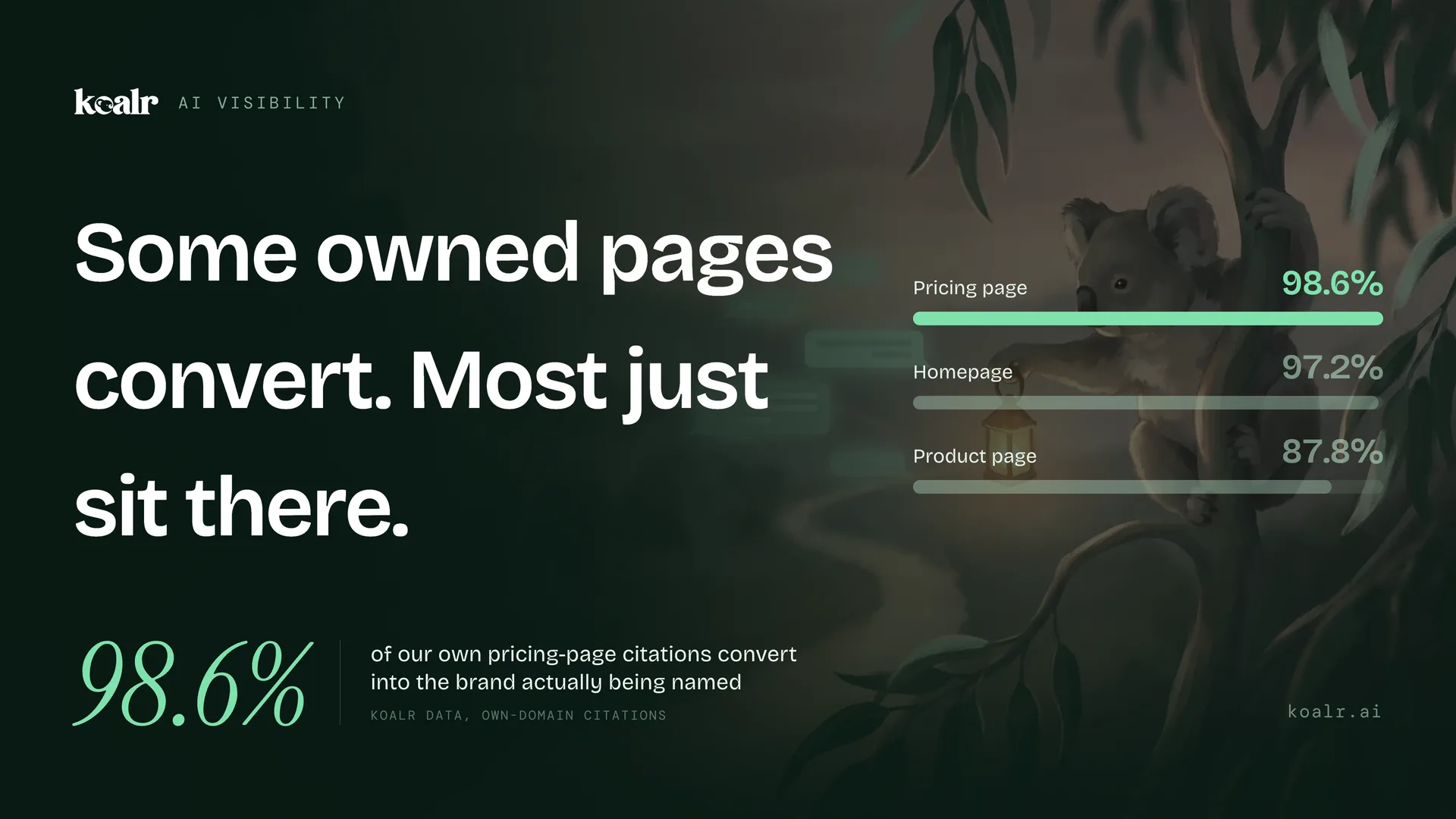
| Owned pages convert unevenly | On our own tracked domains, a pricing-page citation turns into a named mention 98.6% of the time, a homepage 97.2%, a product page 87.8%. |
| It needs a named owner | AI visibility sits between SEO, content, product marketing and demand generation, which is exactly how it ends up owned by nobody. |
What is AI visibility?
AI visibility is whether answer engines such as ChatGPT, Claude, Gemini, Perplexity, Microsoft Copilot, Google AI Overviews and Google AI Mode name, recommend and accurately describe your brand when a real buyer asks a question in your category. It is measured per prompt and per engine, because an engine that recommends you for one question can omit you entirely for the next.
The word "visibility" undersells it slightly. A brand can be visible in the sense of being mentioned once, in passing, in a list of six, and still lose the deal to whichever name the engine said first. What matters is not whether you appear. It is whether the appearance does any commercial work.
AI visibility is a buyer-path metric, not an SEO metric
Traditional search reporting answers a narrower question than it used to: where does a page rank for a keyword. AI visibility answers the question a demand generation leader cares about: what does a potential customer hear when they ask an engine for a solution.
The difference is mechanical. Answer engines do not return a list of ten blue links for a human to evaluate. They synthesise sources, infer which category a company belongs to, weigh competing claims and state a recommendation in prose. A buyer might ask which SOC 2 compliance tools suit a 200-person SaaS company, or what the realistic alternatives to their current CRM are. The engine's answer can name a rival, cite a review site, lean on old product documentation, or simply get your positioning wrong.
Your organic ranking can be strong while the generated answer skips you entirely. A lower-ranking competitor can appear repeatedly because its comparison pages, third-party coverage and product documentation give an engine something clean to retrieve and trust. Ranking well and being recommended well are no longer the same achievement, and a report built for the first tells you nothing about the second.
Buyer asks: “What's the best way to track how our brand shows up in AI search results?”
Claude names two established SEO platforms that have added AI-search modules, describes their monitoring approach in a sentence each, and closes by suggesting the buyer check whether either offers multi-engine coverage before committing.
The same prompt run against a different engine can return a completely different shortlist, with a different brand named first. Neither answer is wrong. Both are the buyer's whole research process.
What does an invisible brand lose?
The risk runs past fewer site visits. AI answers compress research that used to happen across a dozen open tabs. When an engine gives a buyer three plausible options, it can remove five other companies from consideration before anyone has opened a browser.
For a B2B team, that produces four distinct losses, and they are not interchangeable:
- Shortlist loss. Competitors get named as the obvious options while your brand is simply absent from the answer.
- Category loss. The engine files you under the wrong category, which narrows the set of prompts you can ever appear in.
- Trust loss. Outdated claims, thin sentiment or weak third-party evidence make your offer sound less credible than it is.
- Intelligence loss. Without prompt-level monitoring, a team sees softening pipeline and has no way to see the generated answer that caused it.
The fourth loss is usually the expensive one, because it is invisible by design. A monthly ranking report cannot tell a growth leader that Claude recommends a named competitor for enterprise buyers while Perplexity is citing a three-year-old comparison article that leaves your company out entirely. By the time that shows up in a pipeline review, the decision it shaped has already been made.
How do you measure AI visibility?
"Are we showing up in AI search" is too broad to act on. A working measurement system breaks it into observable states and ties each one to a real prompt.
Start with the prompts themselves. Broad category questions matter less than the ones carrying a constraint: a business type, a technical requirement, a budget, a purchase trigger. "Best HR software" is close to meaningless as a signal. "Best HR platform for UK payroll and distributed teams" tells you exactly what a buyer at that stage is deciding between.
Then measure what the engine did with the question:
| Signal | What it tells you |
|---|---|
| Mentioned or absent | Whether you exist in the engine's answer to this prompt at all |
| Recommendation strength | Named first, listed among several, or offered only as a caveat |
| Sentiment | Whether the framing helps or hurts the shortlist decision |
| Cited sources | Which pages the engine drew the answer from |
| Competitors named | Who is winning the same prompt, and how consistently |
Read those five as five, not as one. A headline score is useful for tracking direction over time, but the score is not the action, and blending the five into it destroys the only part you can work with. A 42 out of 100 tells a leadership team almost nothing on its own. What moves the number is knowing that the brand is absent from seven high-intent prompts, has thin citation coverage for one core capability, and loses a direct recommendation to the same two names across three engines. That is a prioritised list of fixes. The score alone is not.
Those numbers matter beyond our own site. A citation is an engine using a page as a source; a mention is the engine naming the brand in the answer. On the pages a company controls directly, homepage, pricing and product pages convert citations into mentions at a far higher rate than the rest of the site does, which is the strongest argument for fixing those three pages before writing anything new.
Why do answer engines disagree with each other?
A brand can appear confidently in Gemini's answer and disappear entirely from Claude's. It can be cited by Perplexity and omitted by Google AI Overviews for the identical question. This is normal, and it is exactly why a single spot check across one engine is close to worthless.
Each engine has its own retrieval habits, its own preferred source types and its own threshold for offering a named recommendation rather than a hedge. Some lean harder on recently published content. Some show their citations openly and some do not. Answers can shift with phrasing, location and how specific the prompt is.
The useful response is not chasing every fluctuation between one run and the next. It is watching for a repeated pattern across engines and across weeks. If a competitor is named consistently across most engines for "best project management software for agencies," that is a real positioning advantage worth studying. If your own brand only appears when the prompt already contains your name, you have demand capture, not category demand creation, and those are different problems with different fixes.
How do you turn a visibility gap into work?
The instinct when a brand is missing from an answer is to publish more content. That is frequently the wrong fix, because the reason an engine skips you is rarely "not enough pages."
If you are missing from a use-case prompt, the likely gap is thin topical evidence: build the page that plainly states what the product does for that use case, who it suits and what it costs, and back the claims with something checkable. If the engine names you but states something wrong, the fix lives on your own pages: tighten the pricing copy, the product description and the plain factual language an engine can lift without inference.
If a competitor wins because independent, third-party sources keep citing them, rewriting your homepage will not move that number. You need the same kind of independent evidence: reviews, comparison coverage, partner mentions, anything that gives an engine a source to trust that is not you talking about yourself.
Technical access sits underneath all of it. An engine that cannot fetch your pages, or that only sees a blank shell because the content renders client-side, has nothing to retrieve regardless of how good the copy is. Fix retrievability before investing in anything else on this list.
See where your brand shows up in AI search
Enter your website and get your AI Visibility Score across 7 engines. First score in under 5 minutes, no setup.
Who should own AI visibility inside the company?
AI visibility crosses more functions than almost anything else in a marketing plan, which is exactly how it ends up belonging to nobody. SEO tends to own technical health. Content owns new pages. Product marketing owns positioning. Demand generation owns the pipeline number the whole exercise is meant to protect.
Give one person the benchmark and the review cadence, without making them personally responsible for writing every page or fixing every technical issue. Their job is narrower: make sure a visibility loss becomes a piece of named work with a commercial reason attached, and make sure someone checks in on it.
Review meaningful shifts weekly and trends monthly. Keep experimental prompts separate from the core buyer-intent prompt set you use to track progress, and record what the engine said before you change anything. Without that record, a team can genuinely improve and have no way to prove which change did it.
A practitioner's view on where the budget goes
The number I have learned to distrust is the score moving on its own. I watched a client's AI Visibility Score climb eleven points in a quarter while their sales team reported flat inbound and a growing sense that the wrong companies kept getting recommended for the deals that mattered. The score was not wrong. It was answering a different question than the one the business needed answered.
The rule I use now: a rising score only counts as progress once it is tied to a named prompt that maps to real pipeline, checked before and after the fix. A number moving because easier or lower-intent prompts entered the monitored set is not the same result, and treating it as one is how a marketing team ends up defending a metric the CFO does not believe.
Here is the concession that costs something to admit: I would rather see three high-intent prompts move from absent to recommended than watch the overall score climb five points across twenty-five. The second looks better on a slide. The first is the one a sales conversation actually feels.
Where Koalr fits
Koalr's free scan runs exactly 25 real buyer-intent prompts across all seven answer engines in under five minutes; tracked plans hold a fixed set from 25 a site on Starter up to 50 on Business. The headline it returns is the AI Visibility Score — the share of those answers naming your brand, from 0 to 100, shown in-app as the Prompt Visibility Rate — with sentiment, citation sources and competitor performance reported next to it rather than folded into it, and prioritised actions attached. Why we stopped blending it is the argument for keeping them apart; this is the discipline they sit inside.
The judgement calls stay judgement calls. Deciding which prompt maps to real pipeline, which gap is worth a quarter of engineering time, and which fix to try first are not things a score can do for you. What Koalr changes is whether you can see the gap at all before it shows up in a forecast review. Plans start at £79 ($99, €89) a month with a 7-day free trial and every engine included from the first scan.
FAQ
Frequently asked questions
Usually one of three reasons: the engine has never retrieved a page that states your relevance to the prompt plainly, a competitor's page gives it cleaner evidence to cite, or your own pages render the key facts in client-side JavaScript an engine never executes. Absence is rarely personal. It is almost always a retrieval problem you can test directly with a curl request against your own pages.
Sources
- Koalr platform data, own-domain citation records: the homepage, pricing and product page citation-to-mention conversion rates cited above, drawn from pages Koalr's tracked brands control directly.
- What is generative engine optimisation?: the wider discipline AI visibility sits inside, including the retrieval and entity mechanics referenced above.
- Prompt tracking: fewer questions, watched properly: how to build the buyer-intent prompt set this piece assumes.
- The AI Visibility Score: why Koalr retired the blended version of the benchmark referenced in the measurement section, and what the number counts now.