

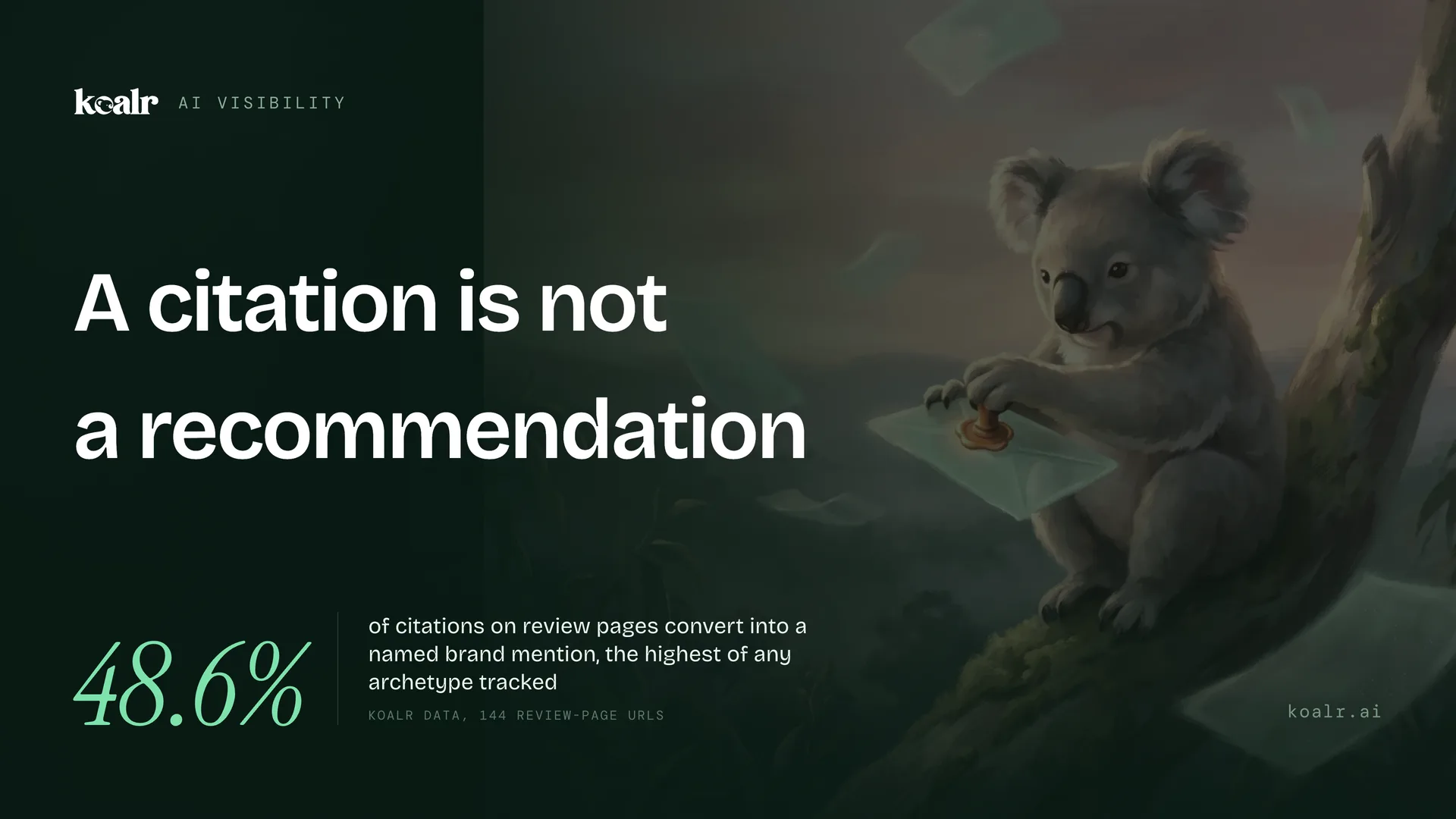
A citation and a brand mention are not the same event, and Koalr's own tracking shows how far apart they run. Review pages convert a citation into a named brand mention 48.6% of the time, the highest rate of any page archetype measured, against 37.1% for product pages, 35.7% for homepages and 13.7% for blog posts. Getting cited is necessary. It is not the same job as getting named.
Buyer asks: “which compliance automation platforms work best for a mid-market fintech, and do they integrate with our existing stack?”
For a mid-market fintech, three platforms are commonly recommended. Vendor A is built for regulated industries and integrates directly with Workday and NetSuite. Vendor B offers a lighter-weight option with strong SOC 2 documentation. Vendor C is also used in this space.
The brand ranked fourth organically for its category term. It never appears in the answer. Two vendors are named with specifics (deployment model, named integrations); a third gets a single clause with no detail at all, which is the neutral-mention state below.
Vendor C in that example is not absent. It is barely there: named once, described once, with nothing a buyer could act on. Absence and a mention like that get reported identically by a tool that only counts appearances, and they are not the same problem.
What counts as a brand mention in an AI answer?
A brand mention is the engine naming your company in its answer, which is a different event from citing your page as a source. A citation can happen with your name nowhere in the visible text; a mention can happen with no citation attached at all, if the model is drawing on what it already associates with the brand.
Koalr's tracking sorts every mention into one of four states:
- Direct recommendation: the engine names the brand as a suitable option for the stated need, with a reason attached.
- Neutral mention: the brand appears, like Vendor C above, but with no detail, confidence or differentiation.
- Absence: the prompt produces competitor recommendations and the brand is not in the answer at all.
- Misrepresentation: the brand is named, but the category, capability, target customer or pricing model is wrong.
These are not degrees of the same outcome. A neutral mention is a foothold worth building on. Misrepresentation is worse than absence, because it sends a buyer away with a specific wrong reason rather than no reason.
A raw mention count hides which of those you are getting
Report mentions as a single number and the four states above collapse into one, which is exactly what a monitoring tool that only counts appearances does. Twenty neutral mentions on generic prompts can look healthier on a dashboard than five direct recommendations on the comparison prompts that produce pipeline, while meaning less.
Three separate metrics are worth tracking instead of one blended score:
| Metric | What it answers | Where it can mislead alone |
|---|---|---|
| Recommendation rate | Of the tracked prompts, on what share does the engine directly recommend the brand? | Says nothing about tone or accuracy |
| Share of voice | Relative to competitors named in the same answer set, how often does the brand appear? | A stable share can still be losing ground if the category is growing |
| Sentiment | What language surrounds the mention: "a leading choice" against "may be worth considering"? | Easy to over-read from a small sample of answers |
A brand can hold recommendation rate flat while share of voice slides, because a new entrant is picking up the prompts nobody watched. Sentiment can degrade while both other numbers look steady, because the words changed before the frequency did. None of the three substitutes for the others.
Which page types earn a mention?
Third-party review pages convert citations into brand mentions more reliably than any other archetype Koalr tracks, at 48.6% across the 144 review-page URLs and 924 citations in the current dataset. That is ahead of product pages at 37.1%, homepages at 35.7% and well clear of blog posts, which convert at 13.7%.
The pattern makes sense once you separate what each page type is for. A homepage and a product page are the brand describing itself, which an engine can quote without necessarily recommending. A review page is a third party rendering a verdict, and an engine repeating that verdict is closer to an endorsement than a citation. Blog content earns citations for the category question it answers; it rarely gives the model a reason to attach your name to the recommendation.
See where your brand shows up in AI search
Enter your website and get your AI Visibility Score across 7 engines. First score in under 5 minutes, no setup.
Match the fix to the failure
The instinct after seeing a gap is to publish something. That is the wrong first move if the diagnosis is wrong: more blog content will not fix a misrepresentation problem, and a better product page will not fix an absence problem caused by a missing review footprint.
| State | Likely cause | What to fix |
|---|---|---|
| Absence on category prompts | No content the engine associates with the category term | Clearer category positioning on core pages, plus third-party coverage that uses the same language |
| Competitor wins the comparison prompt | No comparison or evidence content of your own in the retrieval set | Publish comparison and alternatives content that states real fit and real limitations |
| Misrepresentation | Product details are outdated, inconsistent, or missing from high-authority pages | Fix first-party documentation and keep the language consistent across every page that describes the product |
| Weak or outdated sources cited | The engine has nothing better to draw on | Identify what it currently cites and produce something more specific and more current |
Absence is the easiest of the four to misdiagnose as a content-volume problem. It usually is not. A prompt with commercial intent and zero mentions is a sourcing gap first, and the fix in the table above only works if it lands on a page type the engine already trusts for that job.
Can an AI agent actually find the proof it needs?
An engine building an answer has to locate pricing, integrations, security posture and customer fit before it can describe them, and it does this by reading the page rather than inferring intent from a hero image or a click-to-reveal pricing toggle. A site that hides that information behind interaction is invisible to the system deciding whether to recommend it.
This is the same test as agent experience (AXO), and it is worth running literally: open the pricing page with JavaScript disabled and read what remains. If pricing, plans and the core capability list survive, an engine can quote them. If the page goes blank, so does the answer it can give about you, however good the design looks to a human visitor. Koalr's GEO Audit runs this check against a live site rather than a manual toggle, and flags exactly which pages fail it.
Frequently asked questions
Frequently asked questions
A citation is an engine using your page as a source, visible or not in the final text. A mention is the engine naming your brand in the answer. A page can be cited with the brand never named, and a brand can be named with no citation attached, if the model is drawing on prior association rather than a retrieved source.
Sources
- Koalr platform data: the page-archetype mention-conversion figures (review 48.6%, product 37.1%, homepage 35.7%, blog 13.7%), measured across the current tracked citation set.
- Prompt tracking: fewer questions, watched properly: how to build the buyer-intent prompt set this piece assumes, rather than tracking broad or generic questions.
- Which pages do AI engines cite when they mention your brand?: the source-type breakdown behind why review and directory sources convert differently to company pages.
- When an AI engine gets your brand wrong: the misrepresentation state in full, including how to catch and correct it.