

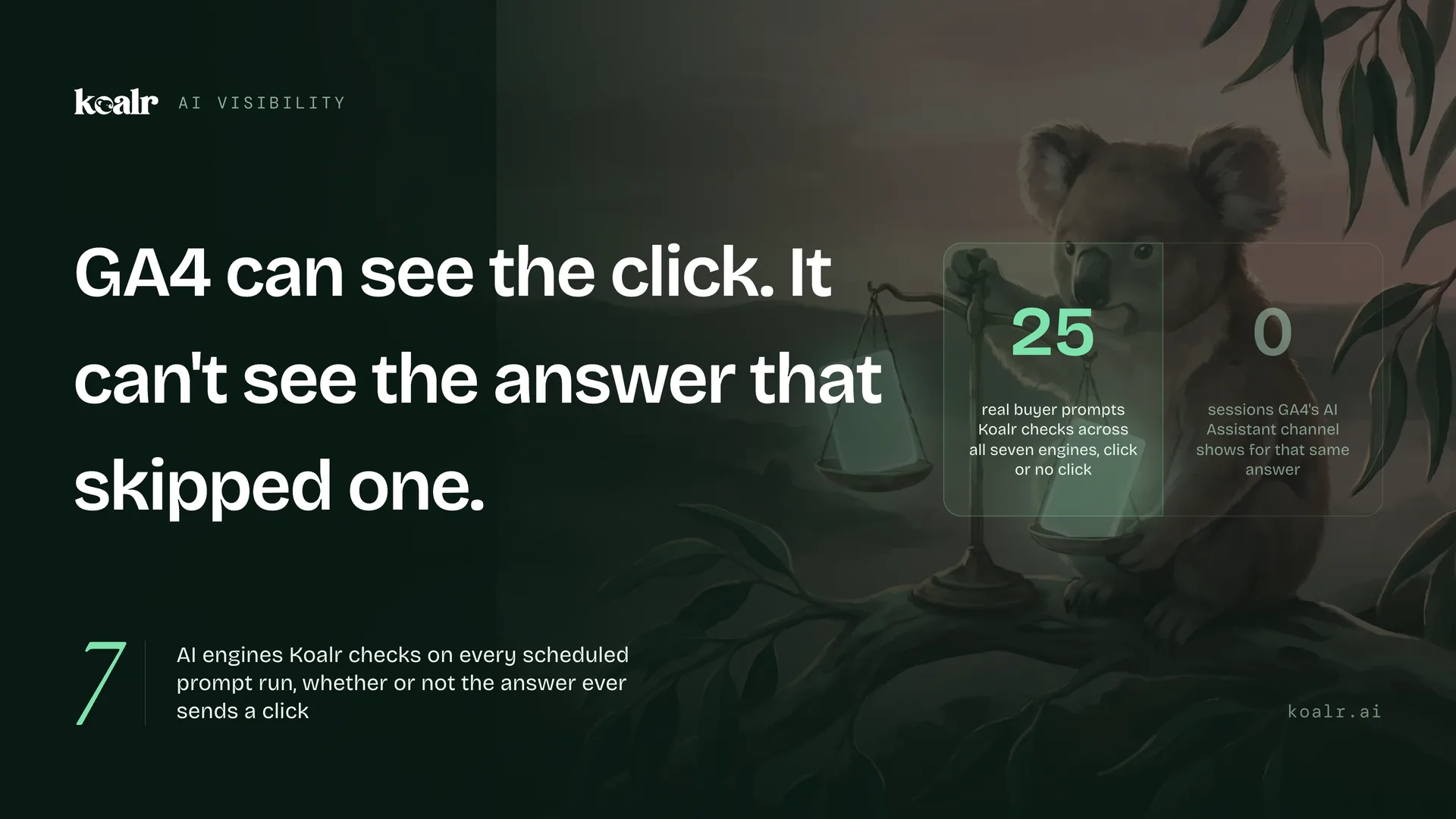
Google Analytics can now tell you when a visitor arrived from ChatGPT. It cannot tell you when ChatGPT named your brand and the visitor never came at all. Those are two different measurements, built by two different kinds of tool, and the growing pile of dashboards built for the first one is not a substitute for the second.
What AI traffic analytics actually measures
AI traffic analytics tracks the visit, not the answer. Google rolled a dedicated AI Assistant channel into GA4 in May 2026, grouping sessions that arrive with a referrer from ChatGPT, Gemini, Claude or another AI surface into their own bucket instead of burying them in Direct or Referral. Similarweb's AI Traffic Tracker and Semrush's AI Traffic Dashboard do the equivalent job from outside your own analytics, estimating how much traffic a domain, including a competitor's, receives from AI chatbots.
Every one of these tools is a session counter wearing a new label. They tell you a click happened, where it landed, and sometimes what it did next. That is genuinely useful, and none of it existed in a clean, labelled form eighteen months ago. It is also a different job from knowing what the engine said about you before that click, or instead of it.
The answer a referral number can't show
An engine that names your product, states your price and tells the buyer to go with you has done its job without asking them to click anywhere. That exchange produces a recommendation and 0 sessions in GA4's AI Assistant channel, not a gap to fix, because there was never a visit to log. As answers get longer and more self-contained, this becomes the default outcome for a well-answered question, invisible to every tool built to count arrivals.
Buyer asks: “does google analytics show me when chatgpt mentions my brand”
Google Analytics 4's AI Assistant channel shows sessions that begin with a click from ChatGPT, Gemini or another AI tool. It only records a visit, so it will not show you when your brand is named or recommended without a click, which AI answers increasingly complete on their own. For that you need a tool that reads the answers directly, not just the traffic they occasionally send.
AI traffic analytics vs AI visibility tracking, side by side
What AI traffic analytics shows
- Sessions that started with a click from ChatGPT, Gemini, Perplexity or another AI surface
- Which pages those sessions landed on and what they did next
- Whether AI-referred visits convert at a different rate than organic search
- Nothing about an answer that never produced a session
What AI visibility tracking shows
- Whether an engine named your brand at all, clicked or not
- Which of your pages, or a competitor's, the engine cited as its source
- How the answer changes across ChatGPT, Claude, Gemini, Perplexity, Copilot and Google's two AI surfaces
- Whether the framing is a recommendation, a neutral mention, or an absence
Why citations and referral traffic move in opposite directions
A brand's mention count can climb across the engines it tracks in the same month its AI Assistant channel in GA4 goes flat, or falls. Separate the two questions and the pattern makes sense. A longer, more complete answer keeps the buyer inside the chat window, which is exactly the outcome a well-optimized page is supposed to produce for the engine that read it. Rising mentions against flat sessions means the citation is doing the job the click used to do. No amount of GA4 configuration brings that session back, because there was never going to be one.
See where your brand shows up in AI search
Enter your website and get your AI Visibility Score across 7 engines. First score in under 5 minutes, no setup.
How do you use both without confusing them?
Keep the AI Assistant channel, or Similarweb, or Semrush, for the job they are actually built for: session volume, landing pages, and whether AI-referred traffic converts differently than search does. That is real, useful, and worth watching on its own terms.
Track citations and mentions separately, engine by engine, against the real questions your buyers ask, whether or not any single one of those questions ever sends a click. How to track your brand in ChatGPT and Gemini covers the manual version of that check, and what it does and does not tell you. Koalr automates it: 25 to 50 real buyer prompts per site, run across all 7 tracked engines on a schedule, condensed into an AI Visibility Score from 0 to 100.
Read the two side by side monthly rather than merging them into one chart. Expect citations to climb while sessions hold flat. Watch instead for citations falling alongside sessions, because that means the engines have stopped bringing you up at all.
Which should you set up first?
If nobody on the team has looked at AI referral traffic yet, start with GA4's AI Assistant channel. It ships inside a tool you already have, and it will tell you within a reporting period whether AI surfaces send you any traffic at all. Layer AI visibility tracking on top once you want the harder answer: what the engines say about you on the questions that never turn into a session, which is where the actual GEO vs SEO split starts to matter. Wait for a click to show up in GA4 first, and you find out you were never mentioned a quarter late, after your buyers already had the answer from someone else.
Frequently asked questions
Yes. GA4 added a dedicated AI Assistant channel in May 2026 that groups sessions arriving with a referrer from ChatGPT, Gemini, Claude and similar tools, instead of leaving them scattered across Direct and Referral. It only counts sessions that actually click through.