

Type "llm seo" into Google and the answers agree on the shape but not the substance: get cited, get structured, write for machines. Almost none of them show a number. LLM SEO is the practice of shaping a page so a large language model retrieves it, trusts it and repeats it, and the practice has measurable levers because retrieval is not a black box. It behaves differently from ranking, and the difference is the whole job.
| Point | Details |
|---|---|
| LLM SEO is GEO's execution layer | Same discipline as generative engine optimisation. "LLM SEO" is what people call it when the target is the model doing the retrieving rather than the answer surface it powers. |
| Retrieval replaces ranking | An LLM does not open a results page. It pulls candidate chunks, scores each one independently, and splices the winners into an answer. |
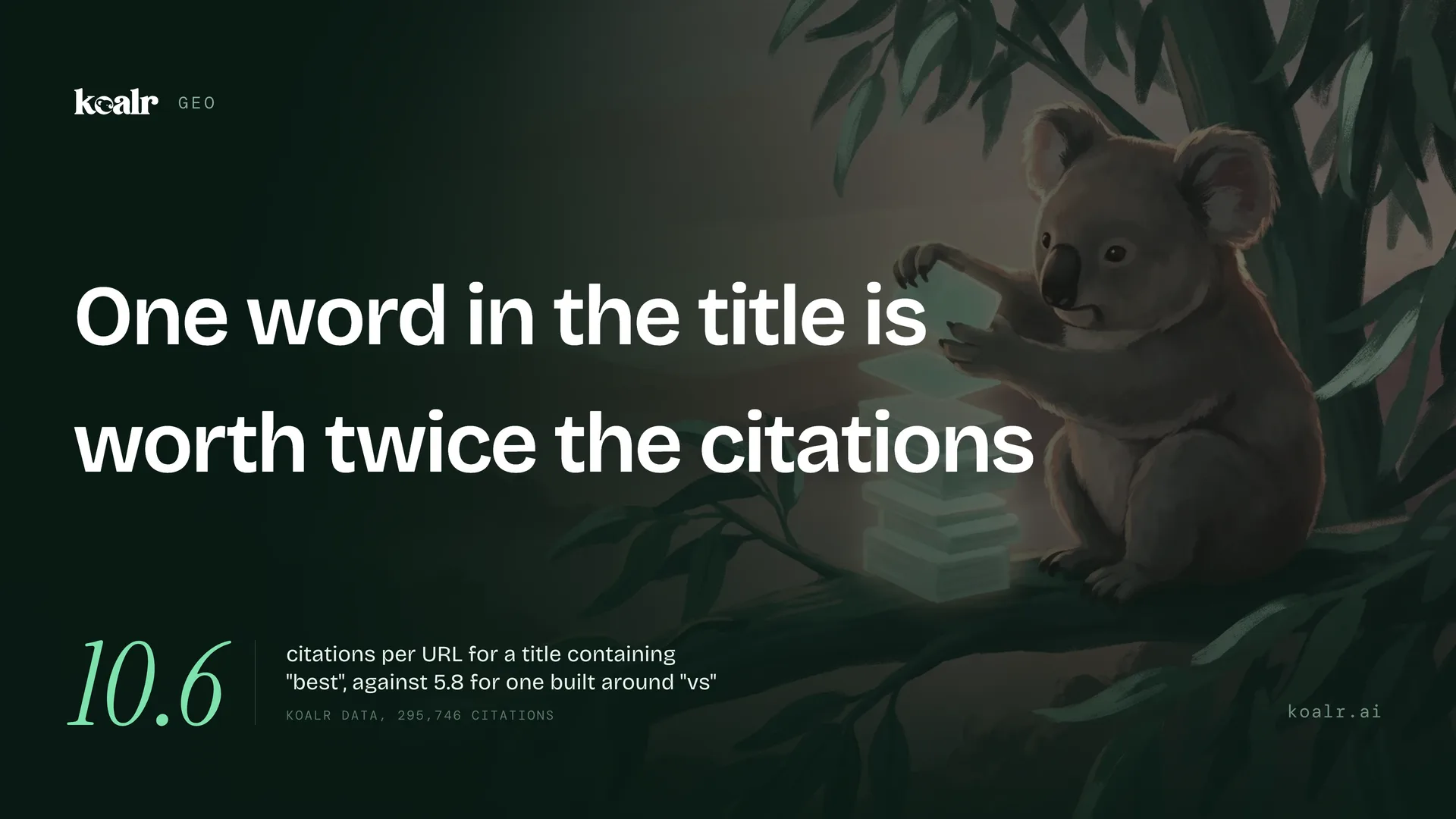
| Title shape is a measurable citation signal | In Koalr's dataset, a title containing "best" earns 10.6 citations per URL against 5.8 for a title built around "vs", a gap wide enough to plan a title around. |
| Structure outperforms length | A small set of structural checks, direct-answer openings, question headings, cited data points, correlates with citations more reliably than word count does. |
| Technical access is the floor | A page a model's crawler cannot fetch does not exist to it, however well it reads. A file at /llms.txt does not fix that on its own. |
What is LLM SEO?
LLM SEO is the practice of structuring content so a large language model can retrieve it, understand it and cite it when generating an answer. It sits inside the wider discipline of generative engine optimisation (GEO), covered in full in what generative engine optimisation actually means. Where GEO describes the whole shift from ranked links to generated answers, LLM SEO is the narrower, more mechanical half: the specific things a page needs so the model doing the retrieving picks it.
Is LLM SEO different from optimising for Google?
It needs its own checklist. The SEO fundamentals still sit underneath it: Google has to crawl and index a page before any AI surface can retrieve it, so broken links, blocked robots and thin authority sink LLM SEO exactly as they sink classic rankings. What changes is the unit getting scored. A search engine ranks whole pages against a query. An LLM scores individual chunks of a page against a question, and only some of those chunks make the final answer. GEO vs SEO covers the full practical split, including which of your own pages carry each discipline.
Buyer asks: “what's the actual difference between seo and llm seo”
Traditional SEO ranks entire pages for a search query using links, keywords and site authority. LLM SEO (also called AI SEO or GEO) optimises content so language models can parse, trust and cite it when generating a direct answer, which rewards clear structure and extractable facts over keyword density.
Notice the answer collapses two separate ideas, ranking mechanics and citation mechanics, into one sentence. The chunk-level scoring underneath is the part a practitioner actually needs, and it rarely survives a one-line summary like this.
How does an LLM actually decide what to cite?
A model does not read a page top to bottom the way a person does. It works from chunks, sections split at natural boundaries such as headings, and scores each one on its own before deciding what earns a place in the answer.
- 1
Retrieve candidates
The engine's index or live crawler pulls a shortlist of pages and chunks that plausibly answer the question, the same universe a search crawler already depends on.
- 2
Score each chunk independently
The model judges every chunk alone, separate from the page it sits in. A chunk that opens with a direct, self-contained answer scores higher than one that opens with a pronoun or assumes the reader already read the paragraph above it.
- 3
Splice the winners into the answer
The engine stitches the highest-scoring chunks, sometimes pulled from several different domains, into the generated response. It shows some as a citation and lets others inform the wording with no visible source at all.
The practical result: a page can be well written and still lose, because one section buries its answer under two sentences of throat-clearing while a competitor's page states the same fact in the first line. Chunk-level scoring is why a comparison page with a table, a definition and an FAQ often beats a single long essay covering the identical ground. It gives the model more independently retrievable, self-contained answers to choose from.
Does your title change whether an LLM cites you?
Yes, measurably. Across Koalr's dataset of 295,746 citations, title wording alone produces close to a two-to-one spread in citations per URL, and the pattern is consistent enough to plan a title around rather than guess at.
Two of these deserve a caveat before you rewrite every headline on the site. "Best" is the single highest-yield pattern, but it only earns that yield on a page that is itself a selection or ranking piece. Force the word onto content that isn't a comparison and it reads as bait; a model can tell when a title doesn't match the body. Question titles sit near the bottom of this table overall but skew heavily toward Google AI Overview and AI Mode, so pick them deliberately when those two surfaces are the actual target.
What page structure do LLMs actually reward?
Title shape gets a page shortlisted. Structure is what gets a specific chunk picked once it is. Koalr's content tooling checks every draft against a short set of rules mined from the same citation dataset, and three of them do most of the work.
None of these are stylistic preferences. A section that opens with "This approach has some drawbacks" instead of naming the approach loses the model's ability to treat that chunk as self-contained, because "this" only resolves if the model also retrieved the paragraph before it, which it may not have. A section with no attributed number in five hundred words gives a model nothing concrete to lift into an answer, so it either paraphrases loosely or skips the section for a competitor's page that did include one. Both failures are invisible to a reader skimming the page and decisive to a model scoring it.
Comparison content carries one more requirement: a markdown table earns the Highest chunk value of any format Koalr tracks, because it survives extraction perfectly where a styled grid or an image does not. Any page comparing three or more things needs one above the fold, not buried under a wall of prose.
See where your brand shows up in AI search
Enter your website and get your AI Visibility Score across 7 engines. First score in under 5 minutes, no setup.
Does technical SEO still matter for LLM SEO?
Technical SEO is the floor everything else stands on. A model that cannot fetch a page, or that only sees an empty shell because the content renders in client-side JavaScript, has nothing to score regardless of how well the copy is written. Perplexity alone takes close to a quarter of its pricing-page citations from pages where the numbers sit in plain server-rendered HTML; a price that only appears after a script runs is invisible to it.
llms.txt gets asked about constantly and deserves a direct answer: it is a discovery convenience that does not influence ranking or citation on its own. The full breakdown covers why crawlable HTML, not a discovery file, is what actually gets a page cited in Koalr's data.
How do you measure whether LLM SEO is working?
Rankings have a mature toolkit built around list position. LLM SEO does not have an equivalent standard yet, so the working substitute is running the real questions your buyers ask against each engine on a schedule and recording who gets named and cited. How to track your brand in ChatGPT and Gemini covers the manual version of that check.
Watch two separate signals. Citation tells you a model retrieved your page as a source. Mention tells you the model went further and named your brand in the answer. They move independently and a page can improve on one while sitting flat on the other, which is the detail a single "are we visible" score tends to hide.
A practitioner's view on which page to fix first
The mistake I watch teams make is treating the structural checklist as something you run once across the whole site before touching anything else. That is backwards, and it is the same mistake as chasing SEO volume by publishing more pages instead of fixing the ones that already carry weight.
The rule I use: pull whichever handful of pages already earn the most organic traffic or the most inbound links, and run the structural checklist against those five before touching page six. A perfectly chunked page nobody links to and nothing crawls regularly is still invisible. A messy page with real authority behind it is one afternoon of edits away from being retrievable.
Here is the part that costs something to admit: I cannot promise a timeline. A page on a domain the model already trusts can pick up a citation within days once the structure changes. The identical fix on a domain with no retrieval history yet can sit for months with nothing to show for it, and there is no reliable way to tell in advance which one you are dealing with. Anyone who quotes you a fixed number of weeks is guessing.
Where Koalr fits
Koalr's GEO Audit checks a page against the structural rules above automatically, and Prompt Explorer runs your buyers' real prompts across all seven tracked engines, ChatGPT, Claude, Gemini, Perplexity, Microsoft Copilot, Google AI Overviews and Google AI Mode, to show which pages are actually getting retrieved and named. The judgement calls, which five pages to fix first, which title genuinely earns "best", stay judgement calls. What the audit removes is guessing whether a page passes the checklist at all. Plans start at £79 ($99, €89) a month with a 7-day free trial and every engine included from the first scan.
FAQ
Frequently asked questions
LLM SEO is the practice of structuring content so a large language model can retrieve, understand and cite it when generating an answer. It covers title wording, chunk-level structure, attributed data points and the technical crawlability that makes retrieval possible in the first place.
Sources
- Koalr platform data, 295,746 citations across 23 tracked brands: the title-pattern and structural figures cited above.
- What is generative engine optimisation?: the wider discipline LLM SEO sits inside, including where the term GEO came from.
- GEO vs SEO: the practical differences: which of your own pages carry each discipline and how to prioritise between them.
- llms.txt is about agent access, not rankings: why crawlable HTML, not a discovery file, is what earns citations in Koalr's data.
- Vercel Engineering, "How we're adapting SEO for LLMs and AI search" (June 2025): a working engineering team's account of restructuring a real site for LLM retrieval, useful for the crawlability angle above.