

Tracking a Google AI Overview means running the same buyer-intent prompts on a fixed schedule and recording three separate outcomes: whether an Overview appears at all, whether your domain is cited as a source, and whether your brand is actually named in the generated text. A monthly screenshot answers none of those reliably, because Google rebuilds the Overview whenever its sources or its model shift, silently. The rest of this covers what to measure, how often, and what to do when a competitor holds the answer instead of you.
What does tracking an AI Overview actually involve?
An AI Overview is a summary Google assembles at query time from whatever it currently ranks highly, cites clearly, and can attribute to a source without contradiction. It is rebuilt on a rolling basis, not published once, so a page that earned a citation in June can be dropped by August with nothing on the page itself having changed.
The practical consequence is that presence in an Overview is a state to monitor, not a milestone to tick off once. How to rank in Google AI Overviews covers what earns the citation in the first place. This is about keeping it, and knowing the moment you lose it.
Buyer asks: “best project management software for a 20-person agency”
The Overview names three vendors, describes each in one line, and links two of the three to their own product pages as sources. The third is named with no source attached, credited on reputation rather than on a specific page. A brand watching only for "am I cited" would miss that this vendor is winning the mention without a citation at all.
Presence, citation and mention are not the same signal
Three separate things can be true or false independently: an Overview can appear for the prompt, your domain can be one of its cited sources, and your brand can be named in the generated text. Conflating the three is the single most common tracking mistake, because a rising citation count can mask a falling mention rate.
The four states an AI answer actually produces, direct recommendation, neutral mention, absence and misrepresentation, apply to Overviews exactly as they do to any other engine. What is specific to Google's two AI surfaces is that they are graded separately: a citation on AI Overviews says nothing about AI Mode, and the reverse. Koalr tracks both as distinct lines among the seven engines it covers, not as one Google row.
What should you actually measure?
Five measures cover the job, and each one catches a failure the others miss: whether the Overview appears at all, whether you are cited as a source, whether you are named in the text, how you compare to competitors named in the same answer, and whether the surrounding language is positive, neutral or actively wrong.
| Metric | What it answers | Where it misleads alone |
|---|---|---|
| Overview presence | Does Google even generate a summary for this prompt? | Presence with zero citations means the query is contested and worth targeting, not a false positive |
| Citation rate | Is your domain one of the sources the Overview draws from? | A citation with no mention means the engine used your page without crediting your brand |
| Mention rate | Is your brand actually named in the generated text? | Watch this alone and you can miss a citation climbing while buyers never see your name |
| Share of voice | How often you appear against competitors named in the same answer | A flat share can still mean losing ground if the category is growing |
| Sentiment | Is the surrounding language positive, neutral, or describing you incorrectly | Easy to over-read from a handful of answers; track the direction, not one snapshot |
Which domains earn the citation in the first place is worth reading alongside this table. Citation rate and mention rate come apart for structural reasons, not random ones, and knowing which page types convert changes what you build next.
The weekly loop, in three steps
- 1
Capture
Run the fixed prompt set on schedule and record whether an Overview appears, verbatim, not from memory.
- 2
Diagnose
Separate presence, citation and mention for each hit. Blending them into one pass/fail number hides which failure you actually have.
- 3
Act
Match the fix to the failure mode, ship it, and re-check on the next cycle rather than assuming the change worked.
Build the prompt set before the dashboard
A tracking programme is only as good as the prompts it runs, and the mistake is starting with a handful of head terms instead of the language a buyer actually types mid-decision. Building a defensible prompt set covers the mechanics in full. The Overview-specific rule on top of that is to weight the set toward informational and comparison-stage prompts, since Google generates an Overview far more reliably for those than for brand-navigational searches.
Cover more than one funnel stage inside the same set. An early research prompt shows whether you are associated with the category at all. A comparison prompt shows whether you survive being shortlisted against named rivals. An implementation-stage prompt shows whether buyers see you as a fit for their specific problem once they are close to deciding.
See where your brand shows up in AI search
Enter your website and get your AI Visibility Score across 7 engines. First score in under 5 minutes, no setup.
How often should you check?
Weekly for the prompts tied to real pipeline, monthly for the wider category set. Google can rebuild an Overview inside a single week when it refreshes the sources behind a query, so a monthly cadence on a high-value prompt means you can lose a citation and not notice for weeks while a competitor holds the answer instead.
Do not overreact to one day's result changing. AI-generated answers are variable day to day, and some prompts will not trigger an Overview consistently even when the category clearly warrants one. Look for a pattern across a defined prompt set checked on a fixed schedule, not a single reading.
Why won't Search Console show you this?
Search Console reports impressions and clicks tied to your organic listings, and it can show whether an AI Overview was present for a given query. It stops there. It does not parse the Overview's generated text, so it cannot tell you whether your brand was actually named or only linked as one of several sources sitting behind the summary.
That gap is why AI Overview tracking is a different discipline from rank tracking rather than an extension of it. A page can sit in position one, receive stable clicks, and still be omitted the moment Google synthesises the answer a buyer reads first. Traditional reporting can look healthy while the thing it does not measure quietly deteriorates.
The mistakes that throw off AI Overview tracking
Four patterns account for most of the bad data teams collect on this:
- Screenshot-only monitoring. A screenshot proves a citation existed at one moment. It is evidence, not a repeatable measurement, and it does not survive being compared to last month's screenshot in any structured way.
- Treating AI Overviews and AI Mode as one line item. They draw on different retrieval passes even though both sit inside Google, and a result on one predicts almost nothing about the other.
- Reacting to a single day's answer. AI-generated answers are variable enough that one reading is noise. A pattern across a scheduled, repeated check is signal.
- Auditing the wrong page. Checking whichever page ranks organically for the query, when the page an Overview actually cites is sometimes a different URL on the same domain entirely.
What should you publish once you find a gap?
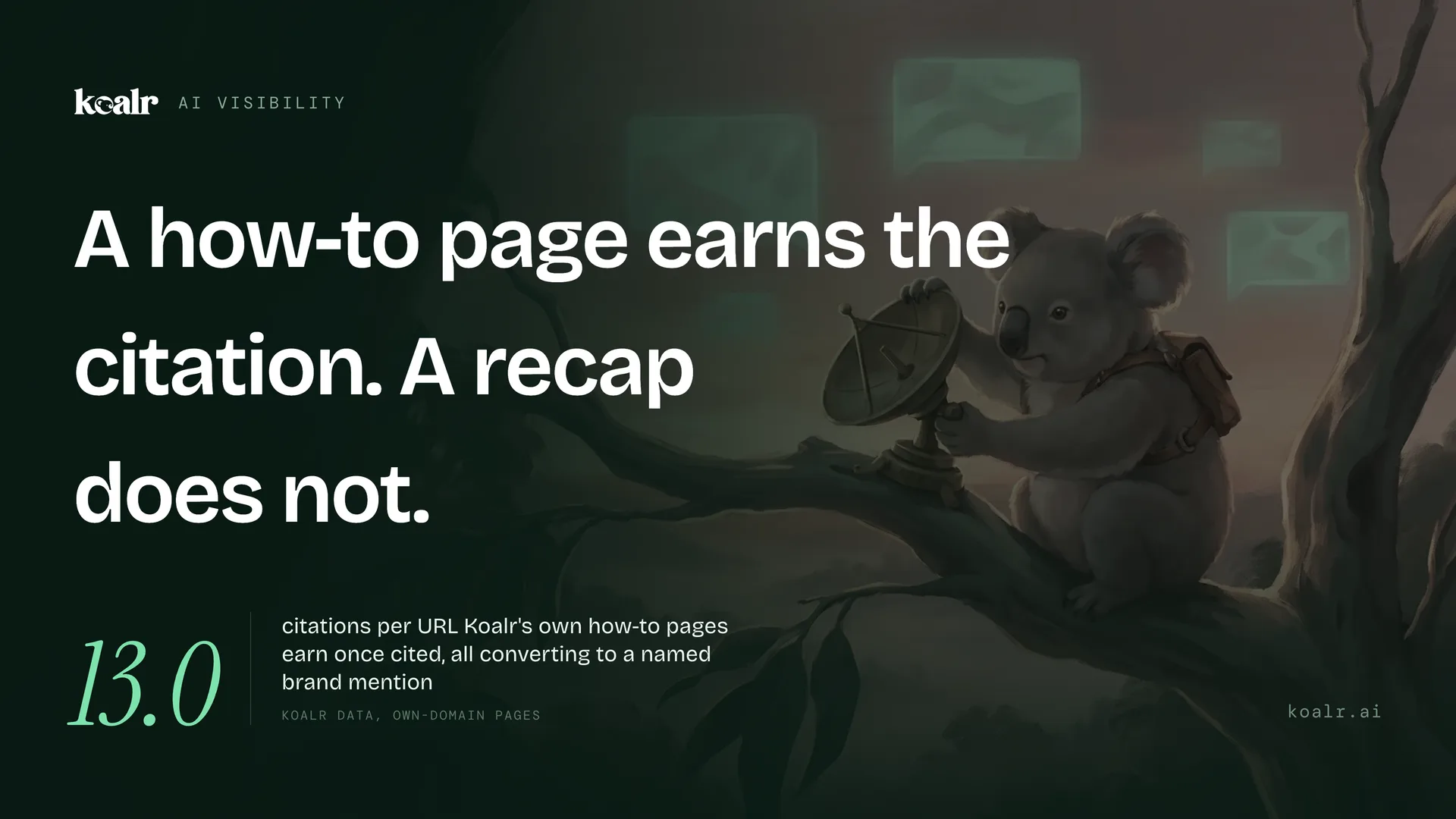
The instinct after finding a gap is to publish something quickly, and the wrong version of that instinct is another blog recap of the topic. On Koalr's own domain, a structured how-to page earns 13.0 citations per URL once cited, and a full-cluster practitioner guide earns 11.8, both converting to a named brand mention every single time they are cited at all.
The structural reason is the one that applies to any brand's own domain: an engine treats a page that directly answers the question differently from a page that recaps a topic around it. How ranking in an AI Overview actually works covers the structure that earns the citation. The point here is narrower: the fix has to be a page shaped like the answer, not a recap of the gap you found.
Key takeaways
| Point | Details |
|---|---|
| Presence, citation and mention are three separate checks | Track all three or a rising citation count can hide a falling mention rate |
| Google runs two AI surfaces, not one | AI Overviews and AI Mode are graded separately; a result on one says nothing about the other |
| Weekly for pipeline prompts, monthly for the rest | Overviews can be rebuilt inside a week when the underlying sources refresh |
| Search Console cannot see the generated text | It shows presence and clicks, not whether your brand was actually named |
| Match the fix to the failure | A citation gap and a mention gap need different content, not more of the same content |
| Structured pages outperform recaps on your own domain | How-to and guide pages earn 13.0 and 11.8 citations per URL once cited, both at 100% mention conversion |
A practitioner's view on tracking AI Overviews
The tension I keep running into is prompt-set breadth against alert fatigue. Track 200 prompts weekly across a category and you generate a report nobody reads past the summary line. Track 15 and you miss the comparison prompt that just started naming a competitor instead of you. The rule I have settled on is a wide set checked monthly and a narrow, pipeline-weighted set of 15 to 20 prompts checked weekly, and a prompt only earns a place in the weekly set once it has actually shown up in a deal, not because it looked important on a keyword list.
The uncomfortable part is accepting the blind spot on purpose. A prompt outside the weekly 20 can lose its citation for a month before anyone notices, and the honest fix is not more automation watching more prompts. It is a smaller set, watched properly, beating a large one nobody actually reads.
Where Koalr fits
Koalr runs a fixed set of real buyer prompts across all seven tracked engines, including Google AI Overviews and Google AI Mode as separate lines, on a repeating schedule, and separates presence, citation and mention rate for each prompt rather than blending them into a single score. Why we stopped blending the number covers how that decision was made and what the AI Visibility Score counts now. The weekly loop this article describes is what runs underneath it, on autopilot instead of by hand.
Frequently asked questions
Frequently asked questions
No. A citation is Google's system using your page as one of the sources behind a generated answer, which does not always include a clickable link and never passes the authority signals a backlink does. Treat it as an editorial credit, not a ranking factor, and measure it separately from your link profile.
Sources
- Which domains earn the citation, and which page types convert it into a mention (Koalr). The per-page-type breakdown behind the metric table above, from the same dataset.
- The four states an AI answer actually produces (Koalr). Covers direct recommendation, neutral mention, absence and misrepresentation in full, referenced above rather than repeated.
- How to build a defensible prompt set (Koalr). The mechanics behind the prompt set this article assumes, including funnel-stage coverage.
- How ranking in Google AI Overviews actually works (Koalr). The structural rules for earning the citation this article is about keeping.
- Why Koalr stopped blending its AI Visibility Score (Koalr). Why presence, citation and mention are reported apart from the single number referenced in the Koalr section above.